
Most people assume that booking a cleaning service means getting the same checklist every time, the same tasks in the same order, regardless of how you actually live or work. That assumption costs people money and leaves them underwhelmed. What is customized cleaning, then? It is the opposite of that: a cleaning approach built specifically around your space, your schedule, and your priorities. This guide breaks down exactly how it works, why it matters, and how to get one set up for your home or business.
Table of Contents
- Key takeaways
- What is customized cleaning, exactly?
- How customized cleaning differs from standard cleaning
- Advantages of a custom cleaning approach
- How to build your own customized cleaning plan
- Misconceptions about customized cleaning
- My take on why customization is worth the extra conversation
- Get a plan built around your space with Smartcleaningwa
- FAQ
Key takeaways
| Point | Details |
|---|---|
| Not all cleaning is the same | Customized cleaning adapts tasks, frequency, and products to your specific space and needs. |
| Documentation prevents problems | A written scope document keeps expectations clear and prevents surprise costs or missed tasks. |
| Start with a deep clean | Beginning with a thorough baseline clean makes all future recurring visits more consistent and effective. |
| Customization saves money | Paying only for what your space actually needs eliminates waste and improves results. |
| Businesses benefit too | Tailored cleaning plans support workplace hygiene, compliance, and professional appearance in commercial settings. |
What is customized cleaning, exactly?
Customized cleaning means building your cleaning service around the actual needs of your space, not around a preset list that every other client also receives. A personalized cleaning plan specifies exactly what tasks are done, how often, and when, designed around actual space use rather than generic checklists.
Think about what that actually means in practice. A household with two dogs and three kids has completely different priorities than a single professional who travels half the month. One needs frequent floor care and upholstery attention. The other might need minimal weekly maintenance but a thorough clean before guests arrive. A one-size-fits-all service fails at least one of them.
The core elements of a customized cleaning plan typically include:
- Task selection: Choosing exactly which areas and surfaces get cleaned each visit
- Frequency: Setting how often each task happens, weekly, biweekly, monthly, or on demand
- Product preferences: Specifying eco-friendly, fragrance-free, or allergen-safe products when needed
- Access and scheduling: Building around your lifestyle, business hours, or tenant availability
- Add-on services: Including specialized tasks like inside appliance cleaning or grout scrubbing only when relevant
The plan is also documented. Clear scope documents listing included tasks, frequencies, and exclusions minimize scope creep and keep both you and the cleaning team aligned. Without that documentation, misunderstandings multiply quickly.
Pro Tip: Before your first appointment, walk through your space and note the three areas that bother you most. That list is the starting point for any genuine customized plan.
How customized cleaning differs from standard cleaning
Standard cleaning and customized cleaning are not just different levels of the same thing. They operate on different logic entirely.
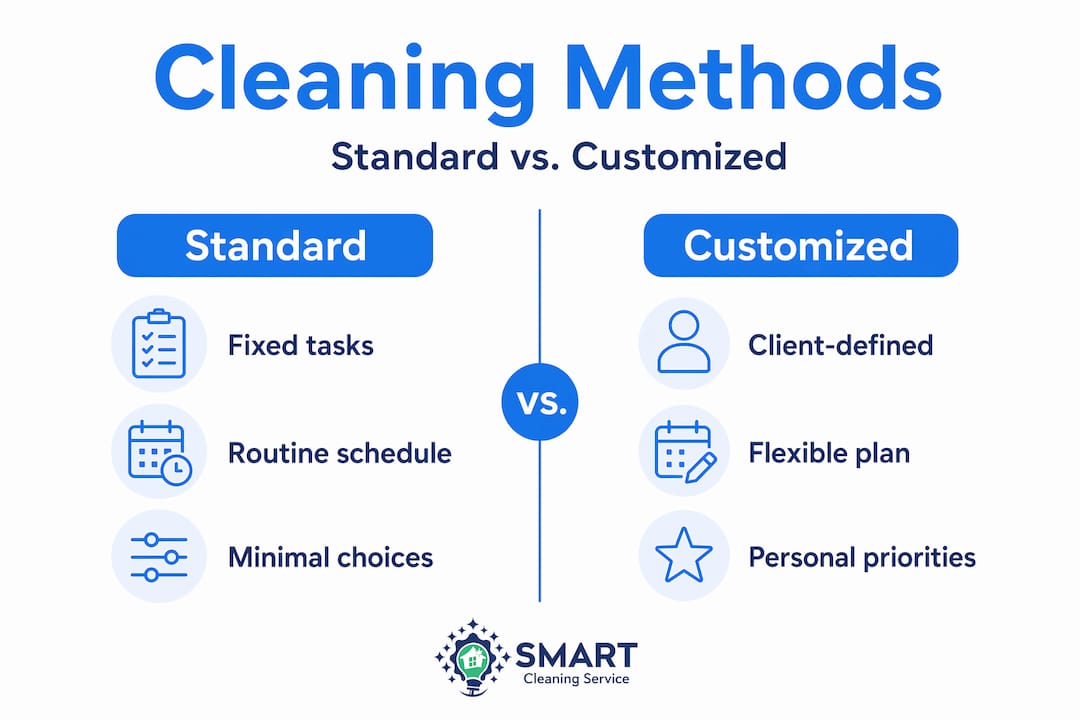
Standard recurring cleaning covers routine surface tasks on a consistent schedule. Vacuuming, mopping, wiping counters, cleaning bathrooms and kitchens. It is efficient, predictable, and works well for spaces with stable, moderate use. Routine maintenance for a typical three-bedroom, two-bath home takes about 1.5 to 3 hours. That scope works for a lot of people, but not for everyone.
Deep cleaning adds another layer. It goes after the buildup that routine visits miss: baseboards, inside appliances, window tracks, grout scrubbing, ceiling fans, behind furniture, and exhaust vents. A deep clean typically takes 3 to 6 hours, reflecting how much more ground it covers.
Customized cleaning sits in a different category because it makes deliberate choices about both of those levels based on what you actually need.
| Feature | Standard cleaning | Customized cleaning |
|---|---|---|
| Task scope | Fixed checklist | Client-defined selections |
| Frequency | Set schedule (weekly, biweekly) | Adjusted to actual space use |
| Add-ons | Rarely included | Built in by preference |
| Documentation | Minimal | Written scope and checklist |
| Cost efficiency | Pay for full package | Pay for what you need |
| Flexibility | Low | High |
Common add-ons that clients often include in customized plans are interior window cleaning, appliance interiors, disinfecting high-touch surfaces, wall washing, and targeted grout cleaning. These tasks would rarely appear in a standard service without explicit discussion.
Pro Tip: If your cleaning provider cannot tell you exactly what is and is not included in writing, that is not a customized plan. It is a standard plan with better marketing.
Advantages of a custom cleaning approach
The benefits of customized cleaning go beyond just getting what you ask for. They compound over time.
Flexibility that matches your real life. Schedules change. You host a holiday gathering, take in a long-term guest, open a second office location, or adopt a pet. A tailored cleaning plan adjusts frequency and scope dynamically, so your service keeps up with you instead of falling behind.
Genuine cost efficiency. Customized plans can be more cost-effective by eliminating unnecessary services and focusing efforts where they matter most. If you never use your formal dining room, you should not pay weekly to have it cleaned. That sounds obvious, but standard packages almost never account for it.
No scope creep. When tasks and expectations are written down, there are no gray areas. You know what to expect, and so does your cleaning team. That consistency builds trust and prevents the frustration of tasks quietly disappearing from your service over time.
Business-grade compliance and hygiene. For commercial clients, customized cleaning supports workplace hygiene, regulatory compliance, and customer impressions. Offices, healthcare facilities, retail spaces, and food-handling environments have unique needs that no generic checklist can reliably address.
- Better health outcomes from targeted sanitizing and allergen control
- Professional appearance maintained on your actual operating schedule
- Reduced liability through documented, verifiable cleaning protocols
The common thread across all these benefits is that customization removes the guesswork. You pay for results in the areas that matter to you, and nothing gets lost in translation.
How to build your own customized cleaning plan
Getting started is more straightforward than most people expect. Here is a practical process you can follow, whether you are setting up a DIY routine or working with a professional service.
Assess your space and usage. Walk each room and be honest about how it gets used, how quickly it gets dirty, and what issues keep coming back. High-traffic hallways and pet-occupied living rooms need more frequent attention than guest bedrooms.
List your priorities and pain points. What bothers you most? What do visitors notice? What areas affect your health or comfort? Start with those. Everything else can be scheduled around them.
Define task frequency. Not every task needs to happen every visit. Some surfaces need weekly attention. Others are fine monthly. Building a cleaning workflow with frequency tiers keeps the scope realistic and affordable.
Decide on product preferences. If someone in your household has allergies, asthma, or sensitivities to fragrance, those preferences belong in the plan from day one, not as an afterthought.
Start with a deep clean baseline. Starting a recurring service with a deep clean first establishes a reliable foundation. It removes the buildup that routine visits cannot efficiently address and makes every subsequent cleaning faster and more predictable.
Document everything. Write down what is included, what is excluded, and what frequency applies to each task. This document is your reference point for evaluating whether service is meeting expectations.
Review and adapt. Schedule a check-in after the first month. Life changes. Your plan should too.
Pro Tip: Ask any prospective cleaning company to show you a sample scope document before you commit. If they do not use one, that tells you a lot about how they handle accountability.
Misconceptions about customized cleaning
A few persistent misunderstandings hold people back from pursuing customized cleaning, and they are worth addressing directly.
“All cleaning companies offer customization.” Many companies use the word without delivering the substance. True customization requires a documented scope, a clear process for updating that scope, and a team trained to follow client-specific instructions. Marketing language is not the same as practice.
“Customized means inconsistent.” The opposite is true. A well-documented plan produces more consistent results than a generic checklist because the team knows exactly what this client expects, not just what most clients expect.
“It always costs more.” Customization can reduce your bill if it removes tasks you do not need. Quality control through checklists and walkthroughs also reduces callbacks and re-cleans, which saves time and money for everyone involved.
“You only need it for large or complex spaces.” A one-bedroom apartment with specific surface materials or chemical sensitivities benefits just as much from a personalized plan as a five-bedroom home does.
The real barrier is communication. When clients and providers talk clearly about expectations up front, customized cleaning becomes straightforward rather than complicated.
My take on why customization is worth the extra conversation
I have worked with enough clients to know that the biggest gap in cleaning services is not effort. It is alignment. Cleaners work hard. Clients care about their spaces. But when no one has actually talked through what matters, the result is a lot of effort pointed in directions that do not solve the real problem.
What I have found is that most clients do not know they can ask for more specificity. They accept the standard package because they assume that is how it works. When I walk someone through the process of building a real plan, and they realize they can say “skip the guest room but spend extra time on the kitchen,” something clicks for them.
The deep clean as a starting point is the piece conventional advice almost always skips. Without that baseline, recurring service is fighting against accumulated buildup instead of maintaining a genuinely clean space. That distinction changes the entire experience.
The contrarian truth here is that customization does not require more complexity. It requires one good conversation at the beginning and a written record of what was decided. That is it. From there, the service runs more smoothly, not less.
— Wilker
Get a plan built around your space with Smartcleaningwa
Smartcleaningwa brings everything covered in this guide to residential and commercial clients across the Greater Seattle Area.
Every new client starts with a conversation about their space, priorities, and schedule. From there, Smartcleaningwa builds a documented cleaning plan tailored to what you actually need, whether that is weekly maintenance for a busy household, a deep clean baseline before moving in, or a flexible commercial plan for your office. Explore how Smartcleaningwa transforms homes with professional, personalized service, or get started with a free estimate and let the team build the right plan for your space.
FAQ
What does customized cleaning mean?
Customized cleaning means tailoring the tasks, frequency, products, and schedule of a cleaning service to match the specific needs of your space rather than following a standard checklist.
What is a customized cleaning plan?
A customized cleaning plan is a written document that defines which tasks will be performed, how often, and under what conditions, built around how the client actually uses their space.
Is customized cleaning more expensive than standard cleaning?
Not necessarily. Tailored plans can be more cost-effective by removing unnecessary services and focusing cleaning time where it has the most impact, so you pay for what your space actually needs.
How do I start customizing my cleaning service?
Start by identifying your highest-priority areas and pain points, then communicate those to your cleaning provider. Ask for a written scope document and request an initial deep clean to establish a reliable baseline.
Can businesses use customized cleaning services?
Yes. Customized cleaning is especially valuable for businesses because it can address industry-specific hygiene standards, compliance requirements, and varying traffic patterns across different areas of the facility.
Recommended
- Smart Cleaning Service™ House Cleaning Seattle Kirkland Bellevue Redmond
- Smart Cleaning Service™ House Cleaning Seattle Kirkland Bellevue Redmond
- Smart Cleaning Service™ House Cleaning Seattle Kirkland Bellevue Redmond
- Smart Cleaning Service™ House Cleaning Seattle Kirkland Bellevue Redmond