
For kitchen work, identify the accessible counters, sink and appliance surfaces to be cleaned. Appliance interiors and other additional tasks should be discussed before the visit.
Table of Contents
- What is move-in cleaning and why is it essential?
- What does a move-in cleaning service include?
- Move-in cleaning vs. regular cleaning: what’s the difference?
- How to choose the right move-in cleaning service in Seattle
- Why most people underestimate move-in cleaning and how to avoid common pitfalls
- Get a fresh start with expert move-in cleaning in Seattle
- Frequently asked questions
Key Takeaways
| Point | Details |
|---|---|
| Move-in cleaning is essential | Confirm the scope before booking |
| Covers more than basic cleaning | Move-in services include deep-cleaning of appliances, cabinets, and hidden surfaces often missed by regular cleaning. |
| Choose local specialists | Confirm the scope before booking |
| Detailed checklists matter | Confirm the scope before booking |
What is move-in cleaning and why is it essential?
For kitchen work, identify the accessible counters, sink and appliance surfaces to be cleaned. Appliance interiors and other additional tasks should be discussed before the visit.
For kitchen work, identify the accessible counters, sink and appliance surfaces to be cleaned. Appliance interiors and other additional tasks should be discussed before the visit.
Dusting can be included for accessible surfaces in the agreed rooms. Point out delicate items, shelves that should be left alone and any areas that need additional attention. Related reading: Routine Cleaning Tasks and Priorities.
Here is what move-in cleaning typically targets that standard pre-move efforts miss:
- Inside and behind kitchen appliances (refrigerator coils, oven interiors, under the dishwasher)
- Interior surfaces of all cabinets and drawers
- Bathroom tile grout and caulking around tubs and showers
- Baseboards, door frames, and light switch plates
- Window sills and window tracks
- Inside closets, including upper shelving and corners
- HVAC vents and ceiling fan blades
The cleaning plan should identify the rooms, tasks and priorities for your visit. Tell the office about access restrictions, delicate surfaces or areas that should be left alone.
Pro Tip: Schedule your move-in/out service after all repairs and touch-up painting are finished but before your moving truck arrives. This gives cleaners unrestricted access to every surface, and you will not need to work around your own furniture.
What does a move-in cleaning service include?
Knowing why move-in cleaning matters, it is important to understand exactly what a thorough professional service actually covers. Not every company does the same thing, so understanding the standard scope helps you hold providers accountable and ask the right questions before booking.
Professional move-in cleaning checklists cover kitchens, bathrooms, and high-touch surfaces as a baseline, but top-tier providers go several layers deeper. Here is a numbered breakdown of what a complete service typically includes from start to finish:
- For kitchen work, identify the accessible counters, sink and appliance surfaces to be cleaned. Appliance interiors and other additional tasks should be discussed before the visit.
- For kitchen work, identify the accessible counters, sink and appliance surfaces to be cleaned. Appliance interiors and other additional tasks should be discussed before the visit.
- Living areas and bedrooms. All surfaces are dusted top to bottom, including shelves, baseboards, window sills, blinds, and ceiling fans. Floors are vacuumed and mopped. Closet interiors are wiped and vacuumed.
- Identify the interior glass or mirrors you want cleaned and confirm which tasks are included. Access and surface condition should be reviewed before the appointment.
- Light fixtures and vents. Overhead lights are dusted or wiped. HVAC vents and return air covers are addressed since they can carry significant dust buildup.
- Final walkthrough and spot treatment. A quality cleaning team does a thorough final check, addressing any spots missed and ensuring every room meets their checklist standard.
Here is a side-by-side look at how move-in cleaning stacks up against a standard recurring clean:
| Task | Standard cleaning | Move-in cleaning |
|---|---|---|
| Surface dusting | Yes | Yes |
| Mopping and vacuuming | Yes | Yes |
| Bathroom scrubbing | Basic | Deep scrub including grout |
| Inside cabinets and drawers | No | Yes |
| Inside appliances | No | Yes |
| Baseboards and door frames | Occasional | Always included |
| Window tracks and sills | Rarely | Yes |
| HVAC vents | No | Yes |
| Closet interiors | No | Yes |
| Light fixtures | Rarely | Yes |
Pro Tip: Ask any potential provider for a copy of their printed cleaning checklist before you book. A reputable company will have no hesitation sharing it. If they cannot produce one, that is a sign their process may lack consistency. You can also review a sample move-out cleaning checklist to understand what a thorough room-by-room breakdown looks like. Understanding residential cleaning standards also helps you evaluate whether a provider is truly professional.
Move-in cleaning vs. regular cleaning: what’s the difference?
To make an informed decision, you should know how move-in cleaning differs from routine cleaning and when each type of service is the right call.
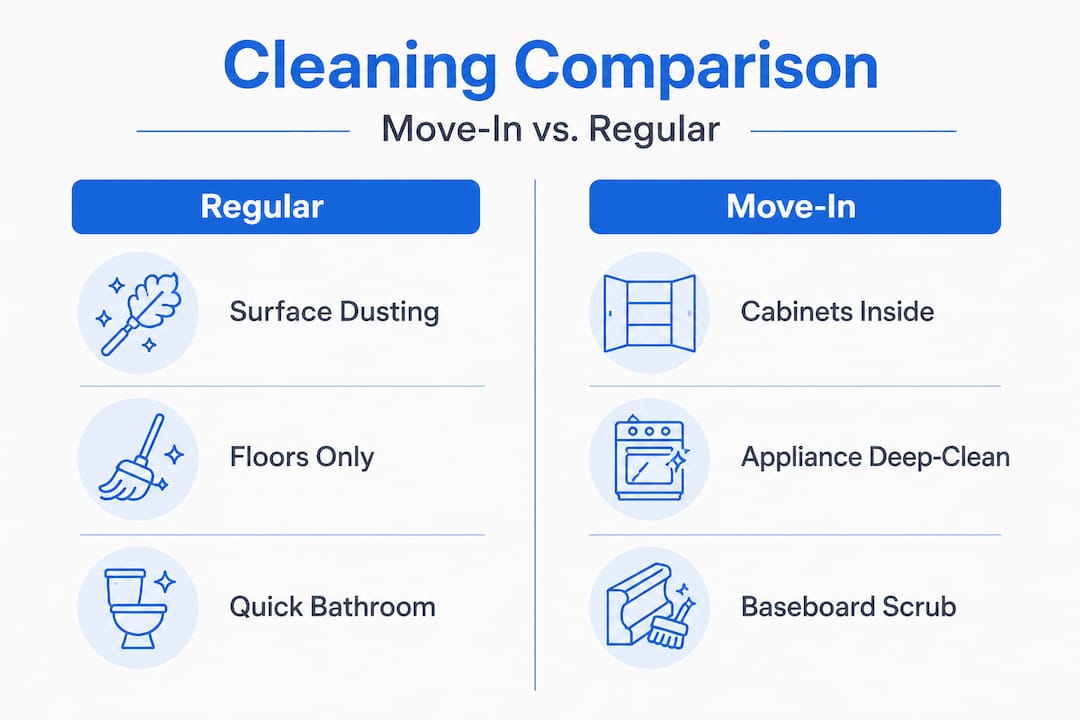
Regular or recurring cleaning maintains a home that is already reasonably clean. A weekly or biweekly cleaner focuses on visible surfaces, floors, bathrooms, and kitchens. They are working efficiently to keep up with normal household accumulation. It works well once you have settled in and established a baseline. What it does not do is address the years of buildup left behind by previous occupants.
Move-in cleaning is more intensive than recurring cleaning because it treats the home as a blank slate. The assumption is that every surface, no matter how it looks, needs a thorough treatment. That is a fundamentally different mindset than maintenance cleaning.
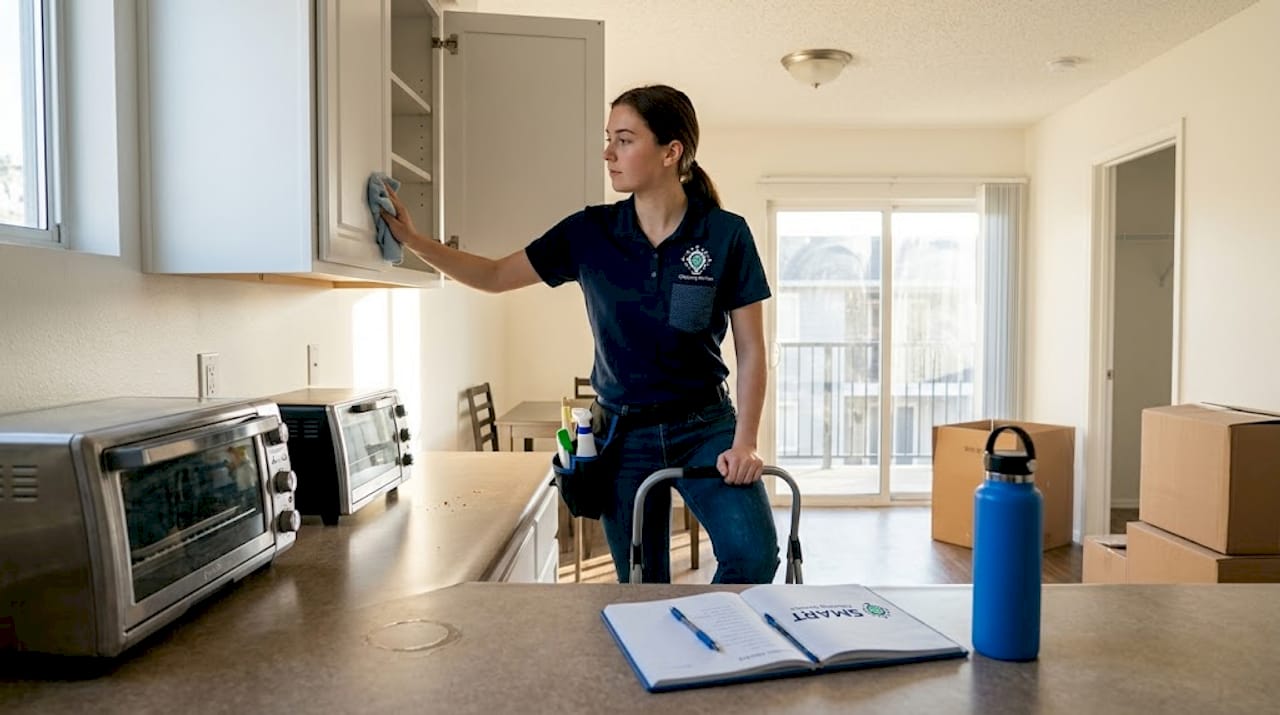
Here is a quick data comparison to illustrate the difference:
| Factor | Regular cleaning | Move-in cleaning |
|---|---|---|
| Frequency | Weekly or biweekly | One-time service |
| Duration | 1 to 3 hours | 4 to 8 hours |
| Inside cabinets and appliances | No | Yes |
| Focus area | Maintenance of clean surfaces | Full reset of all areas |
| Routine surface cleaning | Limited | High priority |
| Best suited for | Active households | New occupants or post-vacancy |
Here are the features that are exclusive to a move-in cleaning service and that you will simply not get from a routine visit:
- For kitchen work, identify the accessible counters, sink and appliance surfaces to be cleaned. Appliance interiors and other additional tasks should be discussed before the visit.
- Full appliance interiors, including the oven, refrigerator shelves, and dishwasher filter
- Scrubbing of bathroom grout and caulking specifically to remove mold and soap scum deposits
- Detailed cleaning of window tracks, which trap moisture, dead insects, and debris
- Treatment of closet floors and shelving where dust and odors tend to accumulate unnoticed
- Degreasing of range hood filters and exhaust fans
List the rooms and accessible surfaces you want cleaned before requesting an estimate. The work completed depends on the agreed priorities, property condition and time used. Related reading: Routine Cleaning Tasks and Priorities, regular cleaning services.
How to choose the right move-in cleaning service in Seattle
Once you know what to expect, you are ready to find a provider you can trust. Here is how to vet your options in the Seattle area so you do not end up with a half-done job right before moving day.
Questions to ask every prospective company:
- Do you provide a written cleaning checklist specific to move-in services?
- Are you licensed and insured, and can you provide proof?
- We use one standard line of professional cleaning products. We don’t supply a separate eco-friendly or pet-friendly product line. If you want a specific product used, please supply it and discuss it with the office before the visit. The team may decline products that aren’t suitable for the task or surface.
- How do you handle a situation where something is missed or a client is unsatisfied?
- For home cleaning visits, we send a message when we are on the way and another when the cleaning is finished. Discuss other communication needs with the office before booking.
- Smart Cleaning Service is licensed, insured and BBB accredited. Service requirements should be reviewed with the office before booking. Insurance coverage depends on the policy and the circumstances of a claim.
List the rooms and accessible surfaces you want cleaned before requesting an estimate. The work completed depends on the agreed priorities, property condition and time used.
Seattle’s housing market brings specific considerations that out-of-town providers may overlook. Older craftsman homes and mid-century properties common in neighborhoods like Wallingford, Ballard, and Kirkland often have unique features like wood paneling, older tile, and cast iron fixtures that require gentler, product-appropriate cleaning methods. Familiarity with the local housing stock matters. Understanding how professional teams organize their work across different property types is a skill that experienced local providers bring to every job.
Red flags to watch for when evaluating a provider:
- No physical address or verifiable business registration
- Pricing given over the phone without asking about home size or condition
- No written checklist or inability to describe the scope of service
- Negative reviews mentioning missed areas or poor communication
- Smart Cleaning Service is licensed, insured and BBB accredited. Service requirements should be reviewed with the office before booking. Insurance coverage depends on the policy and the circumstances of a claim.
- Pressure to pay full amount upfront before any work begins
For routine home cleaning, discuss dusting, floor care, kitchen surfaces and bathroom tasks. Detailed or additional work should be agreed before the appointment.
The bottom line is that price alone should not drive this decision. A $50 cheaper service that misses the inside of your kitchen cabinets or leaves bathroom grout moldy is not a deal. It is a liability you are moving your family into.
Why most people underestimate move-in cleaning and how to avoid common pitfalls
Here is an uncomfortable truth that most cleaning guides skip over. The biggest mistake people make when moving into a new home is not skipping cleaning entirely. It is underestimating what cleaning actually means in this context.
The common thinking goes like this: “The place looks pretty clean. I’ll just give it a quick wipe-down over the weekend before we move in.” That approach misses the entire point. What you can see is almost never the problem. It is the inside of the freezer, the back corners of bathroom vanity cabinets, the HVAC vents coated in years of dust, and the window tracks filled with dead insects and moisture that create real issues down the road.
Routine home and office cleaning is separate from specialist remediation, clinical work or building maintenance. Describe the work before booking and consult an appropriate specialist when it falls outside ordinary cleaning.
There is also the problem of the “cheap option trap.” Budget cleaning services that charge unusually low prices often achieve those rates by cutting time. Less time means fewer areas cleaned. You pay for a move-in clean and get a standard wipe-down. The difference may not be obvious until you open a cabinet and find someone else’s crumbs, or notice your bathroom caulking is still stained months after moving in.
The cleaning’s impact on long-term home comfort is something most people only appreciate after the fact. When a home has been properly reset before move-in, there are fewer odors, fewer allergy flare-ups, fewer appliance issues caused by built-up grease, and a general sense of comfort that is hard to put a number on but easy to notice.
Our perspective at Smart Cleaning Service is this: move-in cleaning is not a luxury item on the moving checklist. It is the foundation. Everything else, from unpacking to decorating to settling in, goes better when you start in a truly clean home. Invest in it properly once and you avoid playing catch-up for the first year of living somewhere new.
Get a fresh start with expert move-in cleaning in Seattle
Moving is already one of the most stressful life events you will experience. Adding “deep clean an entire home on my own” to that list is unnecessary when professional help is available, affordable, and built specifically for this moment.
If something was missed, tell us within 24 hours of your cleaning and we will come back and re-clean that area at no charge, scheduled at the next available time.
Frequently asked questions
How long does a move-in cleaning typically take?
Move-in cleaning can take between 4 to 8 hours depending on the home’s size and overall condition, with larger or heavily soiled properties often requiring more time.
Floor Care and Service Scope
Move-in cleaning services may offer add-ons such as carpet cleaning, but shampooing is not always part of the standard package, so confirm with your provider before booking.
Should I be present during the move-in cleaning?
You do not have to be present, but many clients prefer to do a quick walkthrough before the team starts and again after completion to verify every area meets their expectations.
What is the difference between move-in and move-out cleaning?
Move-in cleaning focuses on preparing a sanitary and welcoming environment for new residents, while move-out checklists target deposit recovery and leaving the space in acceptable condition for the landlord.
How much does a move-in cleaning cost in Seattle?
Residential cleaning starts at $180 for the first hour with the entire three-person team. Additional time is $180 per hour, prorated at $3 per minute. Starting with the second cleaning, recurring residential discounts are 15% weekly, 10% biweekly and 5% monthly, including the first-hour minimum. Existing clients keep their agreed rates. On hourly visits, extra tasks count toward the cleaning time and are not charged separately as add-ons. Fixed-price add-ons apply only to recurring clients on an agreed flat rate when a task is outside the usual scope. Any applicable ride fee remains separate.
Recommended
- Smart Cleaning Service™ House Cleaning Seattle Kirkland Bellevue Redmond
- Smart Cleaning Service™ House Cleaning Seattle Kirkland Bellevue Redmond
- Smart Cleaning Service™ House Cleaning Seattle Kirkland Bellevue Redmond
- Smart Cleaning Service™ House Cleaning Seattle Kirkland Bellevue Redmond