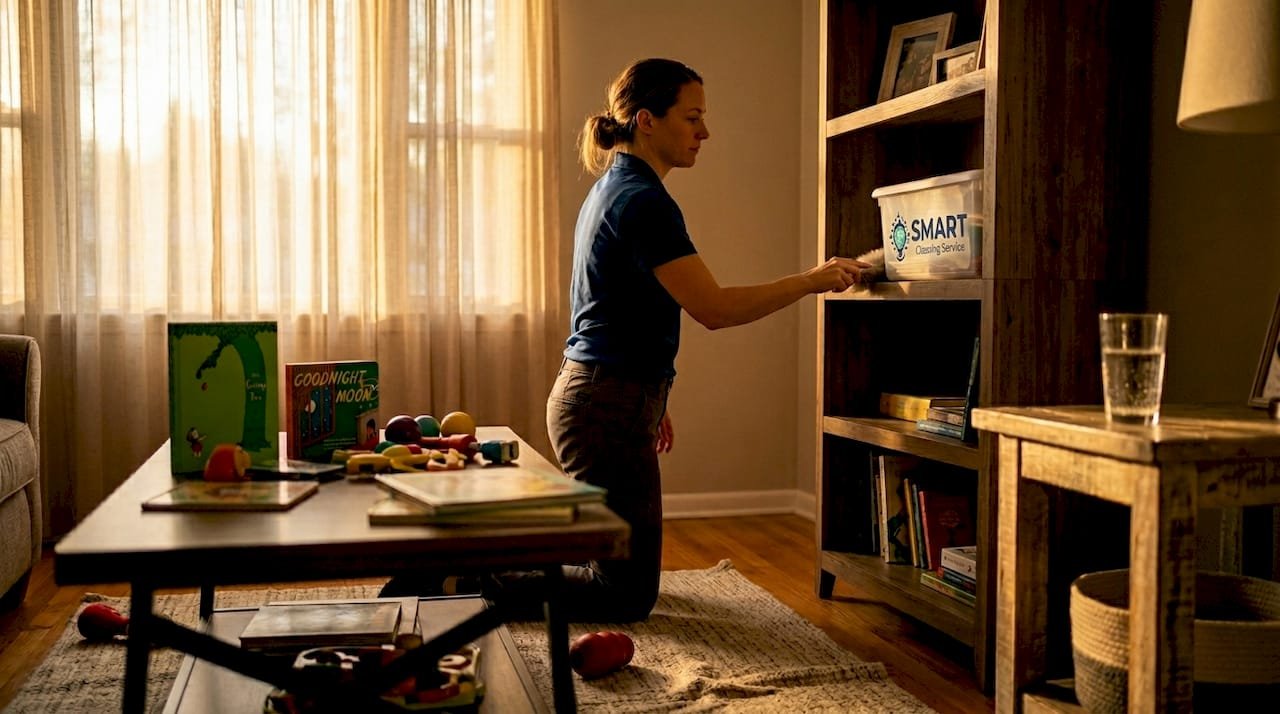
Most homeowners using a maid service are leaving real value on the table. Not because of the service itself, but because of things nobody tells you upfront. How much should you tip? Does decluttering actually matter? Should you hire an agency or an individual? These questions come up constantly, and the answers have a bigger impact on your experience than most people realize. These maid service tips will help you get more from every visit, whether you’re using a service for the first time or trying to get better results from the one you already have.
Table of Contents
- Key takeaways
- 1. Understand the maid service tips on tipping etiquette
- 2. Prepare your home before the visit
- 3. Decide between a maid service agency and an individual cleaner
- 4. Communicate your expectations clearly and consistently
- 5. Know when to request a deep clean versus a regular visit
- 6. Evaluate the quality of your maid service regularly
- 7. Use the right cleaning products for your home’s surfaces
- What I’ve actually learned from watching homeowners use cleaning services
- How Smartcleaningwa can put these tips to work for you
- FAQ
Key takeaways
| Point | Details |
|---|---|
| Tip 15–25% for one-time cleans | Standard tipping ranges from 15–25% of the total cost, with higher amounts around the holidays. |
| Prep your home before the visit | Decluttering and securing pets lets cleaners focus on deep cleaning instead of organizing. |
| Agency vs. individual matters | Professional agencies carry insurance and handle taxes; individual cleaners offer more flexibility but less protection. |
| Clear communication drives quality | Setting priorities in writing and giving feedback after each visit prevents problems from building up. |
| Preparation saves you money | Cleaners who spend less time moving clutter spend more time on the work you’re actually paying for. |
1. Understand the maid service tips on tipping etiquette
Tipping is genuinely confusing in the cleaning industry, and most people either overtip awkwardly or skip it entirely because they don’t know what’s expected. Here’s what the data actually shows.
For a one-time cleaning, tipping 15–25% of the total service cost is considered standard. If your cleaning runs $150, a $22–$37 tip is in the right range. For recurring services, many clients tip $20–$30 per visit and add a more generous amount during the holidays, with $100 being a common holiday benchmark for loyal customers.
When you’re working with an agency team instead of a single cleaner, the math changes a bit. A good rule of thumb is $10–$15 per cleaner for team visits, distributed equally. If you tip one person in a two-person crew and not the other, it creates awkward dynamics.
- One-time cleaning: 15–25% of the total bill
- Recurring service: $20–$30 per visit
- Holiday tip: $75–$100 for a regular cleaner
- Team cleaning: $10–$15 per cleaner on the crew
- Agency vs. individual: Confirm whether the agency pools tips or lets cleaners keep them directly
Pro Tip: Ask your agency upfront whether tips go directly to your cleaner or into a shared pool. If tips are pooled, consider handing cash directly to the person cleaning your home.
Skipping tips for good work isn’t a neutral act. Tipping motivates cleaner performance and builds a positive working relationship over time. Cleaners who feel appreciated consistently report higher job satisfaction, and that shows up in the quality of their work.
2. Prepare your home before the visit
The single biggest waste of money in residential cleaning is paying a professional to move your stuff around. That’s not cleaning. That’s organizing, and it’s eating into time that should go toward the deep work you’re actually paying for.
Decluttering before your cleaner arrives dramatically increases how much actual cleaning gets done. Clear counters get wiped down. Visible floors get vacuumed. Surfaces that are buried under mail or dishes don’t.
Here’s what to do in the 15 minutes before your cleaner shows up:
- Clear countertops in the kitchen and bathrooms so every surface can be disinfected
- Pick up items from the floor so the cleaner can vacuum and mop without obstacles
- Secure your pets in a room, crate, or outside to prevent interruptions and keep animals safe around cleaning products
- Move or lock away valuables including jewelry, medication, and personal documents
- Leave notes about specific priorities or areas that need extra attention
Pro Tip: Keep a small laminated instruction card in a visible spot that tells your cleaner your top three priorities for each visit. This takes two minutes to make and pays off every single time.
The benefit of preparation goes both ways. Your cleaner can work faster and more thoroughly, which means you get more done in the same window. For expert apartment cleaning tips that expand on this, the principle is the same whether you live in 800 square feet or 3,000.
3. Decide between a maid service agency and an individual cleaner
This is one of the most consequential decisions you’ll make, and most people make it based on price alone. That’s a mistake.
The differences go well beyond cost. Professional maid services supply cleaning products, handle tax and insurance matters, carry bonding, and give you a customer service team to call if something goes wrong. If an agency cleaner breaks something or gets hurt on your property, you’re protected. With an individual cleaner, you may be liable depending on how the arrangement is structured.
Here’s a direct comparison:
| Feature | Professional agency | Individual cleaner |
|---|---|---|
| Insurance and bonding | Yes, typically included | Rarely, unless self-arranged |
| Cleaning supplies | Provided by service | Often you supply them |
| Tax compliance | Handled by agency | Your responsibility as employer |
| Accountability | Customer service team | Direct with cleaner only |
| Flexibility | Scheduled system | Often more adaptable |
| Cost | Higher average | Usually lower |
| Consistency | Trained staff rotation | One person, less backup |
Individual cleaners often do exceptional work, and many clients prefer the personal relationship. But you need to know the legal and financial implications before you hire one. If you pay someone more than $2,600 per year to clean your home, you may have household employer obligations under federal tax law.
For Seattle-area residents trying to sort through their options, reviewing a Seattle cleaning company checklist before making a decision is time well spent.
4. Communicate your expectations clearly and consistently
Most cleaning disappointments come down to unclear expectations. The cleaner didn’t know you cared about the baseboards. You assumed the fridge would be wiped down. Nobody talked about it, so nothing happened.

Setting expectations during onboarding is the single biggest factor in long-term cleaning satisfaction. This is especially true in the first few weeks with a new cleaner or service.
A few practices that work reliably:
- Write down your top priorities for each room and share them before the first visit
- Create a shared notebook or checklist that lives in your home and gets updated after each visit
- Give feedback within 24 hours of each cleaning while details are fresh
- Use a proactive check-in after the first three visits to address anything before small issues become habits
- Ask your cleaner directly if anything about your home is making their job harder
Pro Tip: If there’s a language difference between you and your cleaner, laminated instruction cards with images and translated text solve 90% of communication problems without any awkwardness.
When things aren’t going well, contact the agency directly rather than letting frustration build. Reputable services maintain customer support specifically to handle these situations. If you’re working with an individual cleaner, address issues calmly and specifically. “I noticed the bathroom mirror wasn’t cleaned last time” gets better results than a vague complaint.
5. Know when to request a deep clean versus a regular visit
Regular cleaning and deep cleaning are not interchangeable, and treating them as the same thing is one of the most common mistakes people make when scheduling maid service.
Regular visits maintain cleanliness. They cover surfaces, floors, fixtures, and visible areas on a predictable schedule. Deep cleaning targets the places that accumulate grime over months. Think grout, baseboards, appliance interiors, cabinet fronts, and under-furniture buildup. Deep cleaning targets hard-to-reach areas that standard visits don’t address, and it genuinely impacts your home’s hygiene and long-term condition.
A good rule: schedule a full deep clean at the start of a new service relationship, then again every three to six months depending on foot traffic and household size. Your step-by-step deep clean guide can help you understand what’s involved so you know exactly what to request.
If you’re considering a move-in or move-out cleaning, that always warrants a deep clean. Same goes for post-renovation cleanups or returning from an extended time away.
6. Evaluate the quality of your maid service regularly
Hiring a cleaning service is not a set-it-and-forget-it decision. Quality drifts if nobody pays attention, and that’s true of agencies and individual cleaners alike.
Build a simple review habit. Once a month, walk through your home after a cleaning and note what was done well and what was missed. Keep this list somewhere accessible. Share your observations with the service or cleaner in writing so there’s a record.
Top professional maid services invest in ongoing training and regular quality checks to maintain consistency. If your current service can’t tell you how they train their staff or handle quality complaints, that’s a gap worth noting.
Also watch for these signals that it’s time to reassess:
- Repeated misses in the same areas despite feedback
- No acknowledgment when you raise concerns
- Unexplained staff changes with no notice
- Sudden price increases without explanation
Knowing your options makes you a better client. Reviewing local maid service providers periodically keeps you informed even if you’re happy with who you have.
7. Use the right cleaning products for your home’s surfaces
This one catches people off guard. If you have specific flooring, countertops, or fixtures that require particular care, your cleaner needs to know before they start. Hardwood floors, natural stone counters, and stainless steel appliances all have products that damage them if used incorrectly.
Most professional agencies bring their own supplies, which is one of the key benefits of hiring an agency. But if you have surface-specific preferences or sensitivities to certain chemicals, communicate that clearly in writing before the first visit. If someone in your household has allergies or chemical sensitivities, providing your own preferred products is a completely reasonable request.
For towel and linen hygiene as part of a broader home care routine, product choice matters just as much as frequency.
What I’ve actually learned from watching homeowners use cleaning services
In my experience watching how people interact with cleaning services, the pattern is almost always the same. The people who get the best results treat their cleaner like a skilled professional, not an afterthought.
I’ve seen homeowners leave a beautifully written note with priorities, a small tip, and a cold bottle of water on the counter. Their homes consistently get exceptional results. I’ve also seen people who never communicate, never tip, and then wonder why quality feels inconsistent.
The uncomfortable truth is that tipping influences quality of care in a very real way. Cleaners are human. When they feel respected and appreciated, they go the extra mile. When they feel invisible, they do the minimum. That’s not an excuse for poor professional standards. It’s just how people work.
What I’ve also found is that preparation time is the most underrated investment you can make. Spending 15 minutes clearing your home before a visit can result in 45 minutes of additional actual cleaning work. That math is impossible to ignore.
The last thing I’d say: don’t wait until you’re frustrated to speak up. The probation periods of 2 to 4 weeks with a new service exist precisely so you can shape the relationship early, while habits are still forming. Use that window.
— Wilker
How Smartcleaningwa can put these tips to work for you
If you’re looking for a maid service in the Seattle area that takes communication, preparation, and quality seriously, Smartcleaningwa delivers exactly that. Their professional residential cleaning covers recurring house cleaning, deep cleaning, and move-in or move-out services. Every visit comes with real-time updates and a team that shows up prepared.
For homes that need more than a routine visit, their deep cleaning service addresses all the areas that regular cleaning skips. You can also set up regular home cleaning on a schedule that fits your life. Ready to see what quality looks like? Get a free estimate and take the first step toward a consistently clean home.
FAQ
How much should you tip a maid service cleaner?
For one-time cleanings, tip 15–25% of the total cost. For recurring visits, $20–$30 per visit is standard, with a larger holiday tip of $75–$100 for regular cleaners.
Should you clean before a maid service arrives?
You don’t need to clean, but you should declutter. Clearing surfaces, floors, and counters lets your cleaner focus on actual cleaning instead of moving things around.
Is it better to hire a maid service agency or an individual cleaner?
Agencies provide insurance, cleaning supplies, and tax compliance, which protect you legally. Individual cleaners often cost less and offer more personal flexibility, but come with more responsibility on your end.
How often should you schedule a deep cleaning?
Schedule a deep cleaning at the start of a new service relationship and every three to six months after that, depending on household size and usage.
What is the best way to communicate priorities to your cleaner?
Write your top three priorities per room and leave them in a visible spot or share them before each visit. A laminated checklist works particularly well for ongoing communication.
Recommended
- Smart Cleaning Service™ House Cleaning Seattle Kirkland Bellevue Redmond
- Smart Cleaning Service™ House Cleaning Seattle Kirkland Bellevue Redmond
- Smart Cleaning Service™ House Cleaning Seattle Kirkland Bellevue Redmond
- Smart Cleaning Service™ House Cleaning Seattle Kirkland Bellevue Redmond