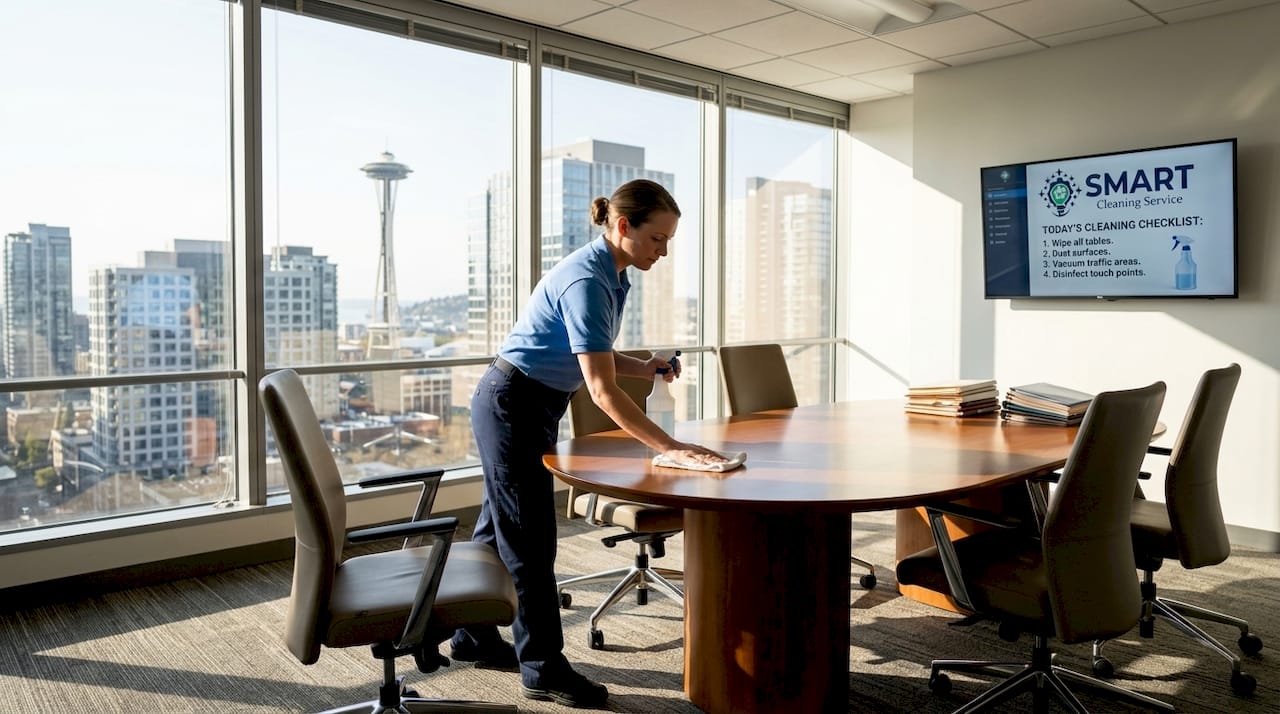
Requirements vary with the property, activity and circumstances. Review the applicable requirements with a qualified adviser; a cleaning appointment does not certify legal or regulatory compliance.
Table of Contents
- Defining commercial cleaning: Beyond just cleaning floors and surfaces
- Standardized processes: How modern cleaning delivers consistency and safety
- Scope and Property Requirements
- The business case: Why well-designed cleaning programs drive real value
- From theory to practice: Building an effective cleaning program
- Why most Seattle businesses underestimate the value of true commercial cleaning
- Get dependable commercial cleaning: Seattle’s trusted choice
- Frequently asked questions
Key Takeaways
| Point | Details |
|---|---|
| Not just surface cleaning | Commercial cleaning in Seattle means documented processes and safety standards, not just wiping dirt from surfaces. |
| Confirm applicable requirements | Confirm applicable requirements |
| Consistency through standards | Confirm the scope before booking |
| Delivers real business value | Clean workspaces improve productivity, tenant satisfaction, and property value when supported by quality cleaning programs. |
| Actionable frameworks exist | Practical planning, from scheduling to documentation, helps Seattle property managers implement successful programs. |
Defining commercial cleaning: Beyond just cleaning floors and surfaces
To understand its importance, let’s clarify what commercial cleaning really entails in a business context.
Many people use “janitorial,” “custodial,” and “commercial cleaning” interchangeably. They’re not the same. Janitorial work typically covers routine, daily tasks like emptying trash, mopping floors, and restocking supplies. Commercial cleaning is a broader, more structured discipline that includes both routine maintenance and scheduled specialty services, all tied together by documented procedures and defined quality standards.
Discuss floor vacuuming and mopping as part of the visit. Tell the office about the floor material and any manufacturer-specific care instructions. Related reading: commercial cleaning programs.
Here’s how commercial cleaning compares to other cleaning types:
| Feature | Residential cleaning | Janitorial | Commercial cleaning |
|---|---|---|---|
| Scope | Home-focused tasks | Routine maintenance | Full-spectrum program |
| Documentation | Rarely required | Basic logs | Required, detailed |
| Confirm applicable requirements | Minimal | Low | Often mandatory |
| Specialty services | Occasional | Rare | Scheduled |
| Risk management | Not applicable | Limited | Central to program |
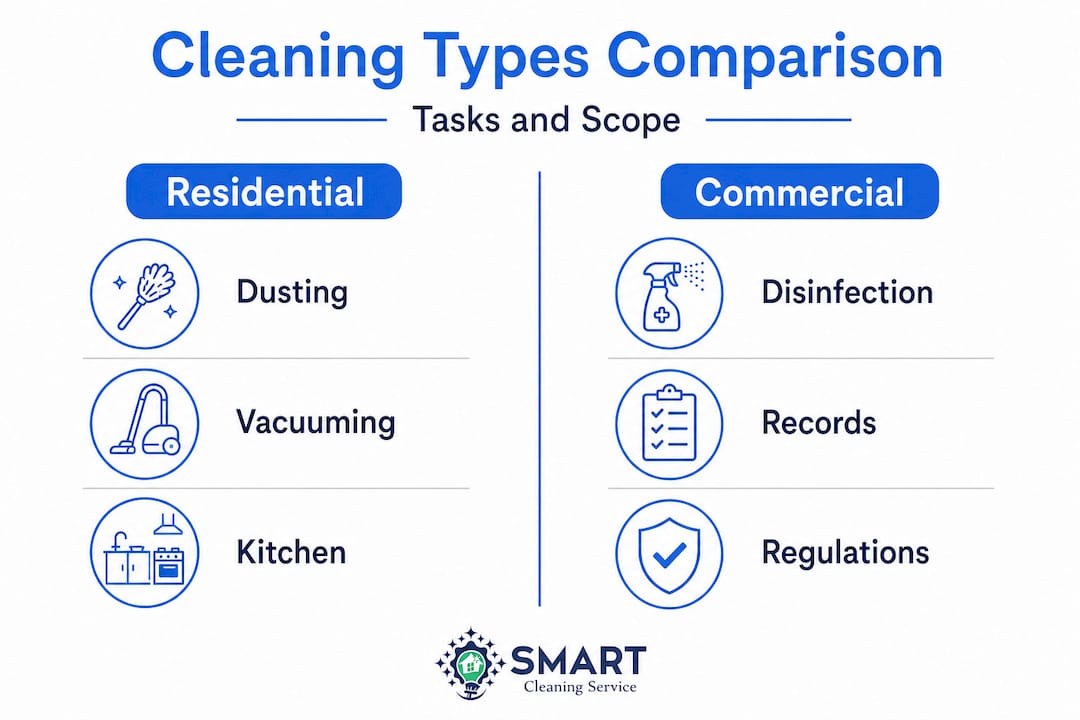
Understanding the difference between residential vs. commercial cleaning helps property managers set realistic expectations and choose the right service level.
Key areas covered in a true commercial cleaning program include:
- For an office cleaning estimate, share the workspace size, access requirements and areas to be cleaned. The scope and schedule should be agreed before service.
- Restroom sanitation with documented chemical protocols
- Routine home and office cleaning is separate from specialist remediation, clinical work or building maintenance. Describe the work before booking and consult an appropriate specialist when it falls outside ordinary cleaning.
- Common area maintenance for lobbies, conference rooms, and break rooms
- Periodic deep cleaning for kitchens, HVAC vents, and hard-to-reach surfaces
“Commercial cleaning methodologies increasingly rely on standardized processes , cleaning sequence, correct chemicals and equipment, required frequencies, and documentation , to reduce risks like cross-contamination and inconsistent results.”
For kitchen work, identify the accessible counters, sink and appliance surfaces to be cleaned. Appliance interiors and other additional tasks should be discussed before the visit.
Standardized processes: How modern cleaning delivers consistency and safety
Once you understand the full scope, it’s clear that meeting modern expectations depends on more than just checklists. Here’s how leading services do it.
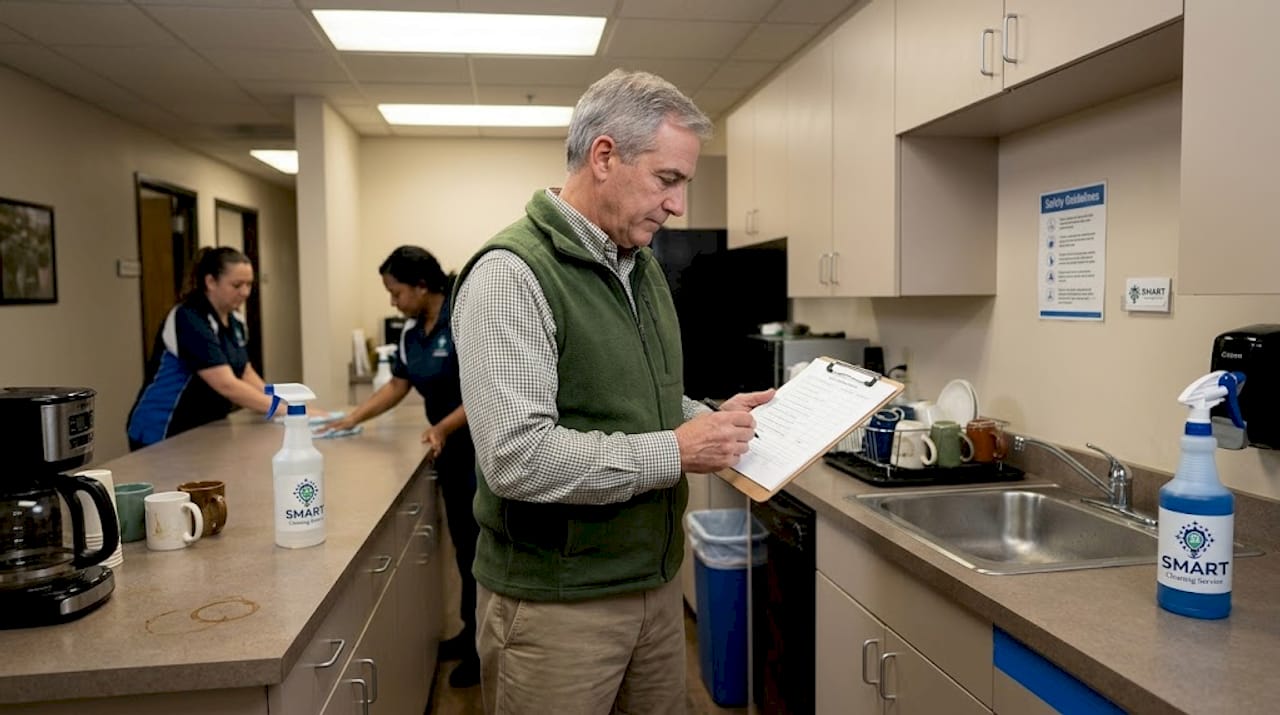
Requirements vary with the property, activity and circumstances. Review the applicable requirements with a qualified adviser; a cleaning appointment does not certify legal or regulatory compliance.
Here’s how a standardized commercial cleaning workflow typically unfolds:
- Zone assignment. The facility is divided into zones based on risk level and traffic volume. Restrooms and kitchens are treated as high-risk; private offices are lower priority.
- Top-down cleaning. All tasks start from high surfaces and move downward to prevent recontamination.
- Color-coded tools. Different colored microfiber cloths and mop heads are assigned to specific zones, preventing cross-contamination.
- Routine office cleaning can include restrooms, breakrooms, accessible work surfaces, floor vacuuming and mopping, and trash removal. Confirm the areas and frequency in the quote.
- Documentation. Completed tasks are logged, signed, and timestamped for accountability.
List the rooms, accessible surfaces and floor areas that need attention. The quote should specify the work and the arrangements for building access.
Requirements vary with the property, activity and circumstances. Review the applicable requirements with a qualified adviser; a cleaning appointment does not certify legal or regulatory compliance.
Explore professional cleaning techniques that reflect these industry-standard approaches in real-world applications.
| Cleaning approach | Task ownership | Consistency | Efficiency |
|---|---|---|---|
| Traditional zone cleaning | One person per room | Variable | Lower |
| Team cleaning | Specialized roles by task | High | Higher |
| Documented protocol cleaning | Standardized across all staff | Very high | Optimized |
Scope and Property Requirements
Because these processes have to stand up to more than just internal standards, let’s look at how Seattle-area policies shape commercial cleaning.
Requirements vary with the property, activity and circumstances. Review the applicable requirements with a qualified adviser; a cleaning appointment does not certify legal or regulatory compliance.
Requirements vary with the property, activity and circumstances. Review the applicable requirements with a qualified adviser; a cleaning appointment does not certify legal or regulatory compliance.
- Mandatory reporting for covered buildings is required by June 1, 2026, making documentation of cleaning programs time-sensitive.
- Properties that fail to comply may face penalties, reduced eligibility for certain programs, or reputational damage with tenants.
- Cleaning frequencies, procedures, and chemical use may all fall under regulatory scrutiny depending on building classification.
- Facilities in high-occupancy, healthcare-adjacent, or food service settings face additional layers of regulation.
Requirements vary with the property, activity and circumstances. Review the applicable requirements with a qualified adviser; a cleaning appointment does not certify legal or regulatory compliance.
Understanding local cleaning regulations matters especially in settings like schools and high-occupancy buildings, where cleaning failure carries the most risk.
The link between cleanliness and compliance is not theoretical. Inspectors, tenants, and building certification programs all evaluate cleanliness as part of broader building quality assessments. A documented cleaning program is one of the fastest ways to demonstrate that a facility is managed responsibly.
The bottom line: If your building qualifies under Washington’s standards and you can’t produce cleaning records, you’re exposed. Not just to inspectors but to tenant complaints, liability, and future lease negotiations where cleanliness is a deciding factor.
The business case: Why well-designed cleaning programs drive real value
Requirements vary with the property, activity and circumstances. Review the applicable requirements with a qualified adviser; a cleaning appointment does not certify legal or regulatory compliance.
The return on a structured cleaning program is measurable across multiple areas. Cleanliness directly affects employee productivity, tenant retention, and the long-term condition of your physical assets. These are not soft benefits. They have real financial weight.
Dusting can be included for accessible surfaces in the agreed rooms. Point out delicate items, shelves that should be left alone and any areas that need additional attention.
Key business benefits of a well-designed commercial cleaning program include:
- For a workplace visit, list the shared areas and accessible surfaces to be cleaned. The cleaning scope, frequency and building access arrangements should be agreed in the quote.
- Lower maintenance costs. Regular floor care, for example, extends the life of hard flooring and carpet significantly.
- Stronger tenant retention. Cleaning and property value are directly connected. Tenants renew leases in buildings where they feel comfortable and cared for.
- Fewer complaints. Documented programs catch problems before they become tenant issues.
- Requirements vary with the property, activity and circumstances. Review the applicable requirements with a qualified adviser; a cleaning appointment does not certify legal or regulatory compliance.
Pro Tip: Schedule a quarterly walk-through with your cleaning provider to review which areas are getting complaints or showing wear. That data drives smarter scheduling and prevents expensive reactive repairs.
For a workplace visit, list the shared areas and accessible surfaces to be cleaned. The cleaning scope, frequency and building access arrangements should be agreed in the quote. Related reading: Routine Cleaning Tasks and Priorities.
From theory to practice: Building an effective cleaning program
To help you take action, here’s how to turn these concepts into an actionable cleaning program for your Seattle-area facility.
Building a commercial cleaning program from scratch or evaluating a vendor’s existing program comes down to six key elements. A documented program that covers all six gives you defensible records and consistent results.
- Map every building zone. Categorize spaces by risk level (restrooms, kitchens, reception, private offices) and traffic volume. This determines cleaning frequency for each area.
- Set documented frequencies. Define daily, weekly, monthly, and quarterly tasks in writing. This is the backbone of your cleaning program and the first thing any inspector or auditor will ask for.
- Specify chemicals, dilutions, and PPE. Every product used should have a documented dilution ratio, intended surface, and required personal protective equipment. No guessing allowed.
- Requirements vary with the property, activity and circumstances. Review the applicable requirements with a qualified adviser; a cleaning appointment does not certify legal or regulatory compliance.
- Implement accountability systems. Digital checklists, supervisor sign-offs, and photo logs are now common in professional cleaning programs. These protect both the building manager and the cleaning service.
- Requirements vary with the property, activity and circumstances. Review the applicable requirements with a qualified adviser; a cleaning appointment does not certify legal or regulatory compliance.
Maintaining commercial spaces in the Greater Seattle Area also means accounting for specific building types, from tech offices in Bellevue to mixed-use retail in Capitol Hill, each with different occupancy patterns and cleaning demands.
Routine home and office cleaning is separate from specialist remediation, clinical work or building maintenance. Describe the work before booking and consult an appropriate specialist when it falls outside ordinary cleaning.
Requirements vary with the property, activity and circumstances. Review the applicable requirements with a qualified adviser; a cleaning appointment does not certify legal or regulatory compliance.
List the rooms, accessible surfaces and floor areas that need attention. The quote should specify the work and the arrangements for building access.
Why most Seattle businesses underestimate the value of true commercial cleaning
Here’s an uncomfortable truth we see regularly: most Seattle business owners treat commercial cleaning as a line item to minimize, not a program to invest in. They shop on price alone, award the contract to the lowest bidder, and then wonder why their building still feels stale, why tenant complaints keep coming in, or why an inspection catches them off guard.
Requirements vary with the property, activity and circumstances. Review the applicable requirements with a qualified adviser; a cleaning appointment does not certify legal or regulatory compliance.
We’ve also seen that tenant satisfaction insights consistently point to cleanliness as one of the top three factors in renewal decisions. Not rent. Not location. Cleanliness. That means a well-run cleaning program isn’t just an operational expense. It’s a retention strategy.
There’s also a risk management dimension that almost never gets discussed in budget meetings. Documented cleaning programs create a paper trail. If a tenant or employee claims they got sick due to unsanitary conditions, or if a slip-and-fall occurs in a space that wasn’t maintained, that documentation is your defense. The businesses that never think about this are the ones who find out too late why it matters.
Compare estimates by the work listed, team size, minimum charge and billing method. Confirm the scope and any additional charges before the appointment.
Get dependable commercial cleaning: Seattle’s trusted choice
If this article clarified how much more commercial cleaning involves than most businesses realize, the next step is working with a team that actually delivers on those standards.
Smart Cleaning Service is licensed, insured and BBB accredited. Service requirements should be reviewed with the office before booking. Insurance coverage depends on the policy and the circumstances of a claim. Related reading: Seattle office cleaning, cleaning estimate.
Frequently asked questions
What tasks are included in a typical commercial cleaning service?
Dusting can be included for accessible surfaces in the agreed rooms. Point out delicate items, shelves that should be left alone and any areas that need additional attention.
How often should offices get professionally cleaned?
Requirements vary with the property, activity and circumstances. Review the applicable requirements with a qualified adviser; a cleaning appointment does not certify legal or regulatory compliance.
Scope and Property Requirements
Requirements vary with the property, activity and circumstances. Review the applicable requirements with a qualified adviser; a cleaning appointment does not certify legal or regulatory compliance.
What makes commercial cleaning different for healthcare or food facilities?
Requirements vary with the property, activity and circumstances. Review the applicable requirements with a qualified adviser; a cleaning appointment does not certify legal or regulatory compliance.
Recommended
- Smart Cleaning Service™ House Cleaning Seattle Kirkland Bellevue Redmond
- Smart Cleaning Service™ House Cleaning Seattle Kirkland Bellevue Redmond
- Smart Cleaning Service™ House Cleaning Seattle Kirkland Bellevue Redmond
- Professional Office Cleaning Services in Seattle, WA