
Most business owners think of cleaning as a line item to minimize, not a lever to pull for better performance. That mindset is costing them. 94% of employees report feeling more productive in a clean workspace, which means every dirty breakroom, dusty desk, and grimy restroom is quietly draining your team’s output. For property managers and business owners across the Greater Seattle Area, where commercial real estate costs run high and competition for talent is fierce, workplace cleanliness is a genuine competitive advantage hiding in plain sight. This guide breaks down the evidence and shows you exactly what to do about it.
Table of Contents
- Why workplace cleanliness matters for productivity
- The connection between cleaning, health, and business outcomes
- Modern cleaning strategies for Seattle businesses
- Practical steps to implement a productivity-focused cleaning plan
- What most leaders miss about cleaning and productivity
- Find expert cleaning solutions for your Seattle business
- Frequently asked questions
Key Takeaways
| Point | Details |
|---|---|
| Clean workplaces drive productivity | A clean office directly improves employee concentration and business output. |
| Healthier staff, fewer absences | Routine cleaning can reduce sick leave by up to 41 percent. |
| Best practices are local | Seattle businesses benefit most from cleaning plans tailored to their unique needs and schedules. |
| Respect cleaning staff | Visible and respected cleaning teams make workplaces healthier and more cohesive. |
Why workplace cleanliness matters for productivity
Having established that workplace cleanliness is more than just aesthetics, let’s explore the hard evidence for its impact.
The research here is not subtle. Clean environments do three measurable things: they sharpen concentration, reduce illness, and lift morale. Each of those outcomes feeds directly into your bottom line, and none of them require a massive operational overhaul to achieve.
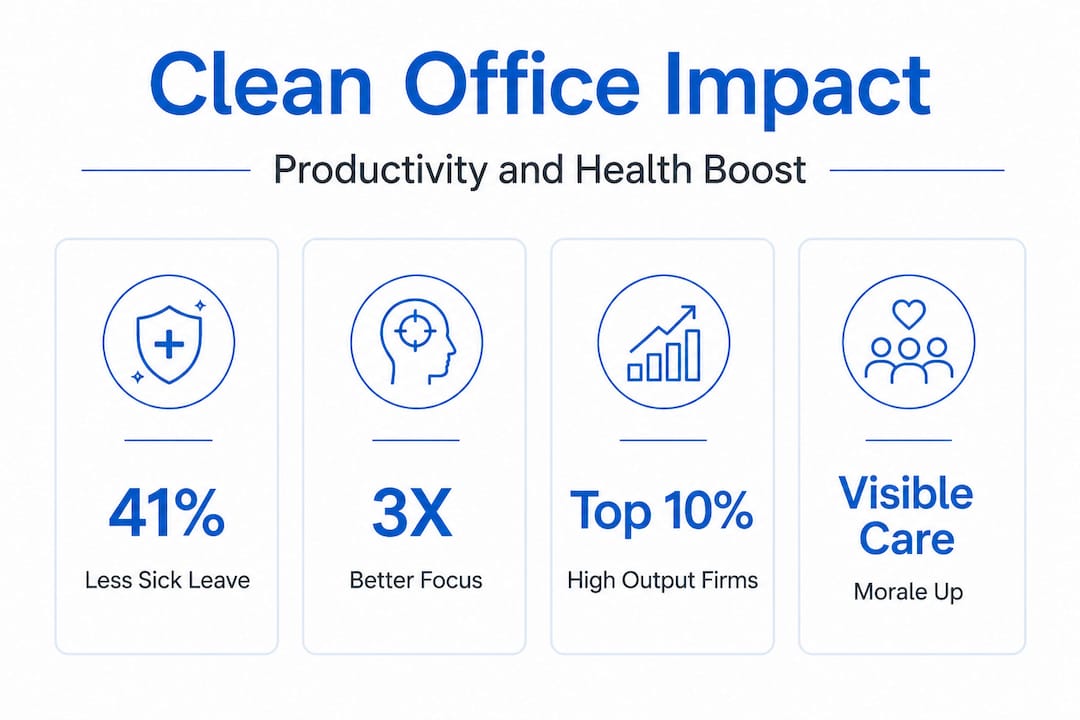
Employees working in clean offices report 77% improved concentration compared to those working in cluttered or dirty spaces. Think about what that actually means for a team of 20 people. If each person is even 10% more focused during an eight-hour day, you’ve recovered the equivalent of a full work day every week from your existing headcount. That’s real output, not theoretical potential.
Here’s what clean environments actually eliminate that dirty ones don’t:
- Visual clutter and disorganization, which pull attention away from tasks and trigger background stress responses
- Allergens and airborne particles, which cause fatigue, headaches, and respiratory irritation that slow cognitive processing
- Unpleasant odors, which research consistently links to reduced mood and lowered concentration thresholds
- Shared surface germs, which spread illness across teams and generate cascading absenteeism
“A clean workplace signals to employees that their environment is being managed and that leadership cares about their experience. That signal alone influences engagement.”
This is why top-performing companies don’t treat Seattle office cleaning as an afterthought. They budget for it deliberately and set specific standards, because they understand that the workspace itself is part of the performance infrastructure.
A 41% reduction in sick leave is tied directly to improved workplace cleanliness, which is one of the most compelling ROI figures any operational investment can claim. Most technology upgrades, wellness programs, or ergonomic improvements can’t come close to that number.
The connection between cleaning, health, and business outcomes
Now that we see cleanliness can drive productivity, it’s critical to understand how it affects employee health and business output.
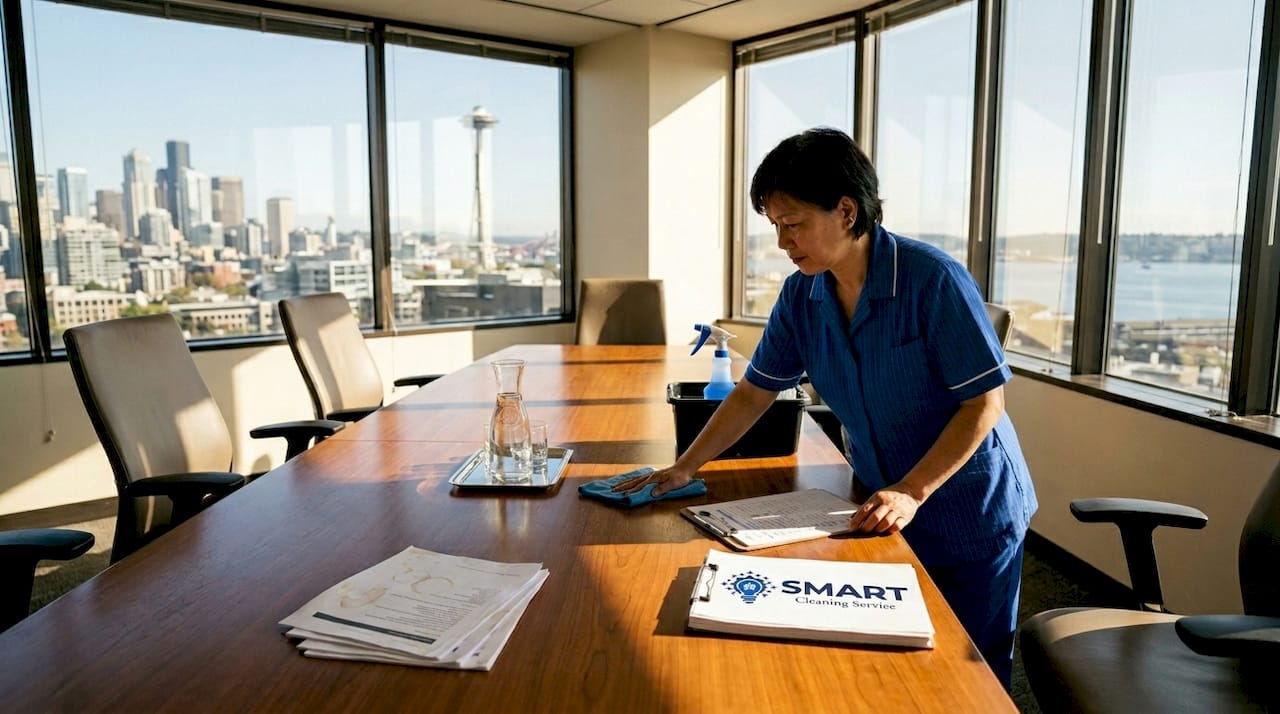
Sick leave is expensive in ways that go beyond the obvious. There’s the direct cost of absent workers, but there’s also the hidden cost of presenteeism (coming to work sick but performing at a fraction of normal capacity), the morale drain on healthy team members who have to absorb extra work, and the ripple effects on client deliverables and deadlines. Keeping employees healthy through a clean environment is one of the most leverage-rich decisions a Seattle business owner can make.
Here’s how routine professional cleaning directly targets the sources of workplace illness:
- Surface disinfection removes bacteria and viruses from shared contact points like keyboards, door handles, elevator buttons, and conference room tables, which are the primary transmission routes for common illness in office environments.
- Air quality maintenance through dusting, HVAC filter cleaning, and proper ventilation reduces airborne allergens and mold spores, both of which are especially relevant in Seattle’s wet climate where indoor humidity creates favorable conditions for mold growth.
- Restroom sanitization addresses one of the highest-risk zones in any commercial building. Properly cleaned restrooms dramatically reduce cross-contamination between team members.
- Breakroom and kitchen cleaning targets the second most common zone for illness spread, where food residue and shared surfaces combine to create a continuous contamination cycle if not cleaned regularly.
The data backs this up clearly. Improved cleanliness reduces workplace sick leave by up to 41%, and that reduction compounds over time. A healthier team builds stronger attendance habits, better team cohesion, and a workplace culture where showing up is the norm.
| Business outcome | Impact of poor cleanliness | Impact of routine professional cleaning |
|---|---|---|
| Sick leave frequency | High, with cascading team effects | Reduced by up to 41% |
| Employee concentration | Lowered by clutter and allergens | Improved for 77% of workers |
| Staff morale | Signaled neglect by management | Signals care and professionalism |
| Client impressions | Risk of negative first impressions | Consistent professional standard |
| Property value | Decline from wear and buildup | Protected through regular maintenance |
Boosting workplace value through cleaning is also relevant to property managers specifically. Tenants notice, and they remember. A building that is consistently well-maintained commands stronger lease renewals and higher satisfaction scores.
For businesses in the Eastside corridor, partnering with a team that understands local commercial building standards makes a real difference. Experienced commercial cleaning in Bothell and surrounding areas means working with professionals who know the specific demands of Pacific Northwest facilities, from managing moisture to maintaining floors treated for Seattle’s weather conditions.
Modern cleaning strategies for Seattle businesses
With the science clear, let’s turn to how Seattle businesses can design a cleaning program that truly fits their workflow and values.
One of the most interesting debates in commercial cleaning today is the question of timing: should cleaning happen during business hours or after the office closes? Both approaches have real tradeoffs, and the right answer depends on your specific workplace culture and priorities.
| Approach | Advantages | Disadvantages |
|---|---|---|
| Daytime cleaning | Ongoing cleanliness, visible care, staff interaction | Requires coordination with work schedules |
| Nighttime cleaning | Zero disruption to workday | Staff never see the work being done |
| Hybrid model | Combines benefits of both | Requires more planning and communication |
Research from Frontiers in Sociology shows that daytime cleaning reduces staff isolation and increases workplace interaction, but it also requires deliberate management to avoid making cleaning workers feel marginalized or overlooked by the rest of the office.
This is a genuinely important point that most operational guides skip entirely. When cleaning happens in the background, at night or out of sight, it can create a workplace culture where cleanliness feels like someone else’s problem. When it happens during the day, done by visible, respected professionals, it reinforces a shared culture of care for the environment.
Here’s how to get daytime cleaning right without disrupting productivity:
- Communicate the schedule clearly so staff know when common areas and restrooms will be serviced
- Position cleaning as a team value, not an inconvenience, by framing it in internal communications as part of the workplace health program
- Acknowledge cleaning staff professionally by training leadership and office managers to treat cleaning professionals as the skilled team members they are
- Coordinate high-activity cleaning for lower-traffic hours, such as mid-morning or early afternoon, when meeting rooms and breakrooms have natural lulls
Pro Tip: Ask your cleaning provider to create a custom schedule that maps their tasks to your team’s actual calendar. A good provider will walk your space, note your peak-use times, and build a rotation around them. This is a hallmark of a professional service and a strong reason to hire a cleaning service rather than relying on in-house ad-hoc efforts.
For businesses that operate across multiple spaces or locations, the logistics of scheduling become more complex. Operators who manage multiple properties or service units often need systems for organizing cleaning teams across different schedules and access windows. Getting this right at scale requires experience and clear protocols.
Practical steps to implement a productivity-focused cleaning plan
Armed with these frameworks, here’s how you can put theory into practice and see real improvements in your business.
The difference between a cleaning program that actually lifts productivity and one that just checks a box comes down to intentional design. Most businesses default to “have someone clean a few times a week” without any specific goals, audit process, or feedback loop. That approach delivers inconsistent results.
Here’s a step-by-step process that works for Seattle-area businesses of all sizes:
Audit your high-traffic and high-risk zones. Walk your space with fresh eyes. Where do people gather? Where do surfaces get touched constantly? Where does clutter tend to build up? In most offices, the answer is the entryway, kitchen or breakroom, restrooms, conference rooms, and shared desks or hoteling stations. These are your priority zones.
Set measurable goals tied to business outcomes. Don’t just say “we want a cleaner office.” Say “we want to reduce team sick days by 20% over the next quarter” or “we want employee satisfaction survey scores for the physical workspace to rise by 15 points.” Concrete targets give your cleaning program real accountability.
Choose a provider with local expertise. Seattle’s climate creates specific challenges including moisture, mold risk, and heavy foot traffic during rainy months. A provider who understands these conditions will treat them proactively rather than reactively. Understanding how pros clean thoroughly in varied environments gives you a baseline for what to expect from a professional service.
Build a feedback loop with your team. 77% of employees concentrate better in clean workspaces, which means your staff are the primary people experiencing the results of your cleaning program. Send a short monthly survey asking about workspace cleanliness, comfort, and any areas of concern. Use that data to adjust your cleaning schedule and scope.
Review and recalibrate quarterly. Workplaces change. Team size shifts, new areas open up, seasonal patterns affect traffic. Your cleaning program should evolve with your business. Schedule a quarterly check-in with your cleaning provider to review what’s working and what needs adjustment.
Pro Tip: For businesses managing both office and residential units, apartment cleaning tips from professional sources can help set baseline expectations across property types so your standards stay consistent regardless of the space type.
What most leaders miss about cleaning and productivity
Here’s what years of cleaning offices across the Greater Seattle Area have taught us: the technical side of cleaning is actually the easy part.
Most business leaders can grasp “clean more often, use better products, hire a professional.” What they consistently miss is the human dimension of the cleaning equation. The research is clear that daytime cleaning reduces isolation of staff, but workplaces must actively avoid marginalizing cleaning workers for that benefit to materialize. When cleaning professionals are treated as invisible or inconvenient, it sends a signal to every other employee in the building: some roles don’t matter. That’s a culture problem, and it affects the very productivity gains you’re trying to achieve.
We see this play out in offices where employees are visibly uncomfortable when a cleaner enters the room, where cleaning carts are hidden from client-facing areas, or where cleaning staff are scheduled to work around a hierarchy of importance. These subtle dynamics undermine morale across the whole team.
The most productive workplaces we work with have something in common: leaders who understand that cleanliness is a shared cultural value, not a vendor contract to minimize. They introduce cleaning staff by name. They include cleaning in their operational conversations. They don’t treat the cleaning budget as the first place to cut when margins tighten.
There are also a lot of outdated assumptions about what professional cleaning can and can’t do. Many of them come from poor past experiences with inconsistent providers. If you’ve been skeptical about outsourcing, it’s worth reading through myths about cleaning companies before writing off professional services entirely. The industry has changed significantly in terms of quality, communication standards, and accountability tools.
Cleaning is infrastructure. Treat it like any other critical business system and you’ll see it perform like one.
Find expert cleaning solutions for your Seattle business
If you’re ready to take action on these insights, here’s where to begin.
Smart Cleaning Service works with business owners and property managers throughout the Greater Seattle Area to design cleaning programs that genuinely move the needle on productivity, health, and workplace satisfaction.
Our Seattle office cleaning services are tailored to your space, your schedule, and your team’s specific needs. We don’t use a one-size-fits-all approach, because a 10-person tech startup in Capitol Hill has different requirements than a 60-person professional services firm in Bellevue. We also understand how cleaning boosts value for property managers who need consistent standards across multiple units. We’re licensed, insured, and focused on reliable communication and real-time updates so you always know exactly what’s been done and when. Reach out today to schedule a walkthrough and get a cleaning plan built around your goals.
Frequently asked questions
How often should offices be professionally cleaned to maintain productivity?
Most offices benefit from professional cleaning at least once per week, with daily touch-ups in high-traffic zones like restrooms, breakrooms, and entryways for the best productivity results.
Does cleaning really help reduce employee sick days?
Yes. Improving cleanliness can reduce workplace sick leave by up to 41%, making it one of the highest-impact investments for attendance and team health.
Are there cleaning methods that boost morale as well as productivity?
Daytime cleaning increases the visibility of cleaning staff and creates opportunities for workplace interaction that can strengthen team culture, provided cleaning professionals are treated with respect and integrated into the workplace environment.
What should I look for in a Seattle-based cleaning service?
Prioritize providers with local experience, verifiable references, knowledge of Seattle’s climate-specific cleaning challenges, and clear communication systems so you’re never left guessing about the status of your service.