
An insured cleaning service is a cleaning provider that carries active insurance policies covering property damage, bodily injury, and liability claims that occur during cleaning operations. The industry standard term is “licensed and insured cleaning service,” and it signals that the company has transferred financial risk away from you. General liability insurance, workers’ compensation, and surety bonds are the three core policies involved. Together, they protect your home, your belongings, and your finances if something goes wrong during a cleaning visit.
What is an insured cleaning service, exactly?
An insured cleaning service holds at least one active insurance policy that responds when accidents happen on your property. The most common policy is general liability insurance, which covers accidental property damage and third-party injuries during cleaning work. That means if a cleaner breaks a window or a visitor trips over a mop bucket, the insurance pays, not you.
Many customers assume “insured” covers everything, including theft. That is a costly misconception. Bonds, general liability, and workers’ compensation are separate products with separate purposes, and you need to verify all three for complete protection. A company that advertises “insured” without specifying which policies it holds may leave significant gaps in your coverage.
The phrase “licensed and insured” adds one more layer. Licensing confirms the company meets local legal and regulatory requirements. Insurance confirms it can pay for mistakes. Both matter, and neither substitutes for the other.

What types of insurance do cleaning companies carry?
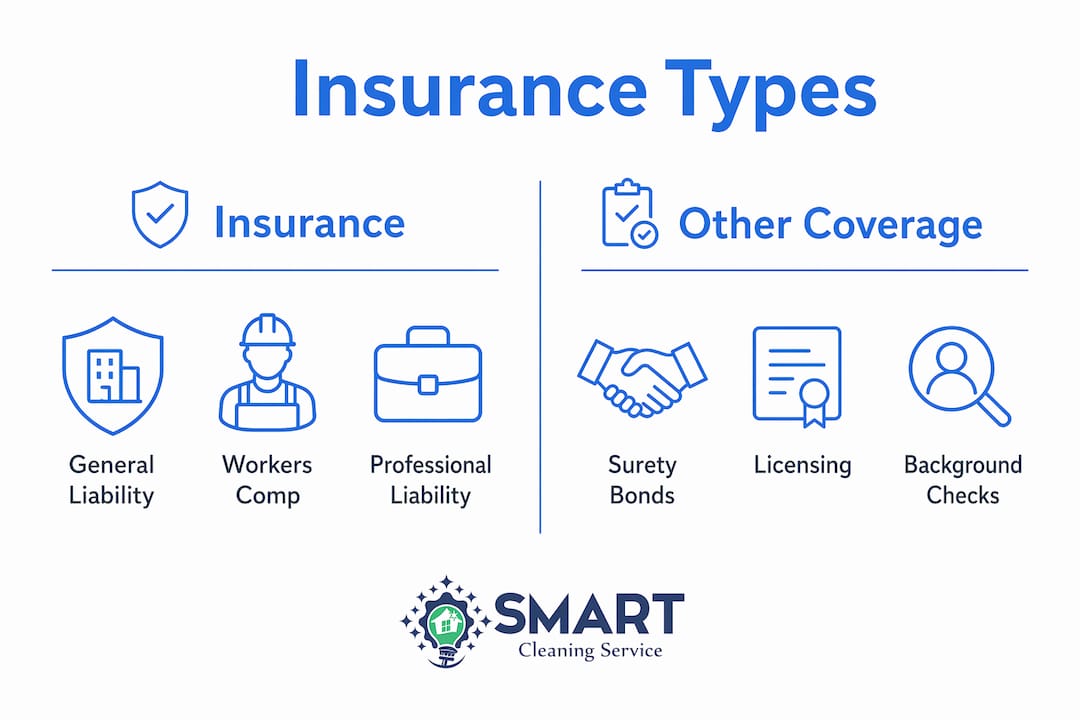
Cleaning service insurance is not a single policy. It is a stack of distinct coverages, each addressing a different category of risk.
General Liability Insurance covers accidental damage to your property and injuries to third parties during cleaning. If a cleaner knocks over an antique lamp or a client slips on a wet floor, this policy responds. It is the baseline policy every professional cleaning company should carry.
Workers’ Compensation Insurance protects the cleaning staff if they are injured on the job. Many states legally require cleaning businesses with employees to carry workers’ comp. This matters to you because without it, an injured cleaner could potentially pursue a claim against your homeowner’s or business insurance instead.
Professional Liability Insurance covers claims that a cleaning company performed its work negligently. If a client argues that improper cleaning caused damage, this policy responds where general liability may not.
Surety Bonds work differently from insurance. A surety bond reimburses clients for theft, fraud, or employee misconduct during a cleaning visit. Bonds are not insurance. They are a financial guarantee that the company will make you whole if an employee steals from you.
| Coverage Type | What It Protects Against | Who It Pays |
|---|---|---|
| General Liability | Property damage, third-party injury | Client or injured party |
| Workers’ Compensation | Cleaner injury on the job | Injured employee |
| Professional Liability | Negligent service claims | Client |
| Surety Bond | Employee theft or fraud | Client |
Pro Tip: Ask for the policy number and coverage limits for each type, not just a verbal confirmation. A company with $100,000 in general liability coverage may not be enough to replace high-value items in a luxury home.
How does insurance protect you when hiring a cleaner?
Hiring an insured cleaning company shifts financial risk off your shoulders. Uninsured cleaners expose clients to paying for damages and injuries out of pocket. That exposure is real: a broken glass shower door can cost $500 or more, and a worker injury on your property without workers’ comp coverage can trigger a lawsuit.
The protections you gain from an insured provider include:
- Direct claim rights. If you are named as an additional insured on the cleaner’s policy, you can file claims directly with the insurance company. This is critical if the cleaning company becomes uncooperative or goes out of business.
- No personal liability for worker injuries. Workers’ comp coverage means the cleaning company’s insurer handles medical costs, not your homeowner’s policy.
- Theft reimbursement. An active surety bond covers you if an employee steals from your property.
- Accountability and documentation. Insured providers operate with formal contracts and complaint procedures, unlike informal uninsured operators.
“Insurance signals long-term stability and professionalism, making insured cleaning companies preferred partners for risk-averse clients.” — Turno Industry Insight
The contrast with uninsured cleaners is stark. Uninsured workers often operate informally without business registration and avoid liability. If something goes wrong, your only recourse is small claims court, and collecting a judgment from an informal operator is rarely straightforward.
How do you verify a cleaning company is truly insured?
Verification takes less than ten minutes and protects you from companies that claim coverage they do not actually carry.
- Request a Certificate of Insurance (COI). A COI is the standard proof document issued by an insurance company. It lists the policy types, coverage limits, and expiration dates. Any legitimate insured cleaning company will provide one on request without hesitation.
- Check coverage dates and limits. Confirm the policy is active, not expired. Policies can lapse or carry low limits that do not fully protect you. A general liability limit below $500,000 may be insufficient for commercial properties.
- Ask to be named as an additional insured. This gives you direct claim rights with the insurer. It is a standard request that reputable companies accommodate without issue.
- Confirm bonding status separately. Ask for the bond certificate, the bonding company’s name, and the renewal date. For properties where cleaners have keys or access codes, an active surety bond is non-negotiable. Check bond renewal annually.
- Review policy exclusions. Some general liability policies exclude certain types of damage, such as mold or water damage from cleaning errors. Ask the company to clarify what its policy does not cover.
- Request updated proof periodically. Do not rely on a COI from six months ago. Ask for a fresh copy at least once a year or before any major cleaning project.
Pro Tip: Call the insurance company listed on the COI directly to confirm the policy is active. It takes two minutes and eliminates any risk of a forged or outdated document.
Bonded vs. insured vs. licensed vs. background-checked
These four terms appear together constantly in cleaning company marketing, but they mean very different things. Conflating them leads to real gaps in your protection.
Licensed and background-checked cleaners add compliance and screening beyond insurance. Here is how each credential breaks down:
| Credential | What It Covers | How to Verify |
|---|---|---|
| Insured | Property damage, injury, liability | Request COI with policy details |
| Bonded | Employee theft and fraud | Request bond certificate |
| Licensed | Legal compliance, regulatory qualifications | Check state or city business license |
| Background-Checked | Employee criminal history screening | Ask for screening policy and provider |
No single credential covers all risks. A company can be insured but not bonded, meaning you have no protection against theft. A company can be licensed but carry no insurance, meaning you bear all accident costs. The strongest providers carry all four credentials and can document each one on request.
For an insured janitorial service or commercial cleaning context, licensing requirements are often stricter. Commercial clients should verify that the company’s license covers the specific type of facility being cleaned, whether that is a medical office, a food service space, or a standard commercial building.
Why choose insured cleaning services for rentals and businesses?
The role of insured cleaners in rentals is especially significant. Property managers and landlords face compounded liability because they are responsible for both the property and the tenant experience. Bonding is non-negotiable when providing cleaners with keys or access codes to rental properties. A single theft incident without bond coverage can cost a landlord thousands in property losses and legal fees.
The advantages of insured cleaning extend well beyond rentals:
- For homeowners: You avoid out-of-pocket costs for accidental damage and protect yourself from liability if a cleaner is injured in your home.
- For Airbnb hosts: Turnover cleaning between guests involves repeated access to your property. An insured and bonded cleaner protects your inventory and your guest reviews.
- For businesses: Commercial cleaning insurance protects customer-facing spaces. If a cleaner causes a slip-and-fall in your lobby, the cleaning company’s liability policy responds first.
- For property managers: High-end residential and commercial clients prefer insured cleaners as part of their risk management approach. Insurance is a baseline requirement, not a bonus.
The cost trade-off is straightforward. Insured cleaning companies typically charge more than informal operators. That premium buys you financial protection, documented accountability, and a professional relationship with clear recourse if something goes wrong. One uncovered incident with an uninsured cleaner can cost more than years of the premium you avoided paying.
Key takeaways
An insured cleaning service is the only responsible choice when someone else has access to your property, your belongings, and your liability exposure.
| Point | Details |
|---|---|
| Insurance covers three risk categories | General liability, workers’ comp, and surety bonds each address different risks. |
| Always request a COI | A certificate of insurance confirms active coverage, limits, and policy types. |
| Ask to be named additional insured | Direct claim rights protect you if the cleaning company becomes uncooperative. |
| Bonded is not the same as insured | Bonds cover theft; insurance covers damage and injury. Verify both separately. |
| Uninsured cleaners carry real financial risk | Clients pay out of pocket for damages and injuries when no insurance exists. |
Insurance is the first question, not the last
I have reviewed dozens of cleaning company profiles over the years, and the single most reliable indicator of a professional operation is not the equipment they use or the products they carry. It is whether they can hand you a current COI without hesitation.
Most clients ask about price first and insurance last, if at all. That order should be reversed. A company that cannot produce proof of coverage within 24 hours of your request is telling you something important about how it operates. The vetting checklist for hiring a cleaning company should start with insurance verification, not end with it.
The other thing I see overlooked constantly is the distinction between bonded and insured. Clients hear “we’re insured” and assume they are covered for everything. They are not. If a cleaner takes a piece of jewelry and the company carries no surety bond, you have no financial recourse beyond a police report. Ask specifically about bonding every time.
One more thing worth saying plainly: the advantages of insured cleaners go beyond money. Insured companies operate with contracts, complaint procedures, and accountability structures that informal operators simply do not have. That structure protects you in ways that are hard to quantify until you need them.
— Wilker
Smartcleaningwa provides fully insured cleaning in seattle
If you are searching for a cleaning provider that meets every standard described in this article, Smartcleaningwa serves the Greater Seattle Area, including Kirkland, Bellevue, and Redmond, with fully licensed and insured residential and commercial cleaning.

Smartcleaningwa carries general liability insurance and is bonded, and the team provides proof of coverage to clients on request. Services include recurring house cleaning, deep cleaning, move-in and move-out cleaning, Airbnb turnover cleaning, and office cleaning in Seattle. Every visit comes with real-time updates and documented communication so you always know what happened in your space. For insured residential cleaning in the Seattle area, Smartcleaningwa is a provider you can verify before you book. Request a free estimate and get proof of coverage with your quote.
FAQ
What does “insured cleaning service” mean?
An insured cleaning service carries active insurance policies, typically general liability and workers’ compensation, that cover property damage, injuries, and liability claims during cleaning work. These policies protect clients from paying out of pocket if an accident occurs.
Is bonded the same as insured for a cleaning company?
No. Bonded means the company carries a surety bond that reimburses clients for employee theft or fraud. Insured means the company holds insurance policies covering damage and injury. Both are separate and both matter.
How do i verify a cleaning company is actually insured?
Request a Certificate of Insurance directly from the company and confirm the policy is active, the coverage limits are adequate, and the policy types include general liability and workers’ compensation. You can also call the insurer listed on the COI to confirm the policy status.
Why does insurance matter for rental property cleaning?
Property managers and landlords give cleaners direct access to their properties, making bonding and insurance non-negotiable. Without coverage, a theft incident or accidental damage during a turnover clean becomes the property owner’s financial problem.
What is the difference between licensed and insured cleaning?
Licensed means the company meets local legal and regulatory requirements to operate. Insured means it carries active insurance policies covering accidents and liability. A fully credentialed cleaning company holds both, along with a surety bond and employee background checks.
Recommended
- Smart Cleaning Service™ House Cleaning Seattle Kirkland Bellevue Redmond
- Smart Cleaning Service™ House Cleaning Seattle Kirkland Bellevue Redmond
- Smart Cleaning Service™ House Cleaning Seattle Kirkland Bellevue Redmond
- Smart Cleaning Service™ House Cleaning Seattle Kirkland Bellevue Redmond