
Understanding key cleaning industry terms is the foundation of every successful cleaning relationship, whether you manage a commercial property in Seattle, rent out an Airbnb, or simply want to know what you are paying for when a cleaning crew shows up. Terminology in this field derives from contractual usage, trade standards like ISSA and IICRC, and regulatory definitions from the EPA, FDA, and CDC. Some terms carry legal weight. Others shift meaning depending on the platform, the contract, or the marketing copy. This guide cuts through the confusion and gives you a working vocabulary that protects your investment and sets clear expectations.
What are the key cleaning industry terms professionals use daily?
The cleaning industry draws its vocabulary from three distinct sources: regulatory agencies like the EPA and FDA, trade organizations like ISSA and IICRC, and the contracts and platforms where services are bought and sold. That last category is where most misunderstandings happen. A term like “deep cleaning” means something precise to a trained technician and something entirely different on a booking platform. Knowing the difference puts you in control of any service conversation.
Cleaning industry terminology also carries real compliance weight. A property manager who confuses “sanitizing” with “disinfecting” in a lease agreement or service contract may be setting a standard they cannot actually verify or enforce. Getting the vocabulary right is not pedantic. It is practical.
What’s the difference between cleaning, sanitizing, disinfecting, and sterilizing?
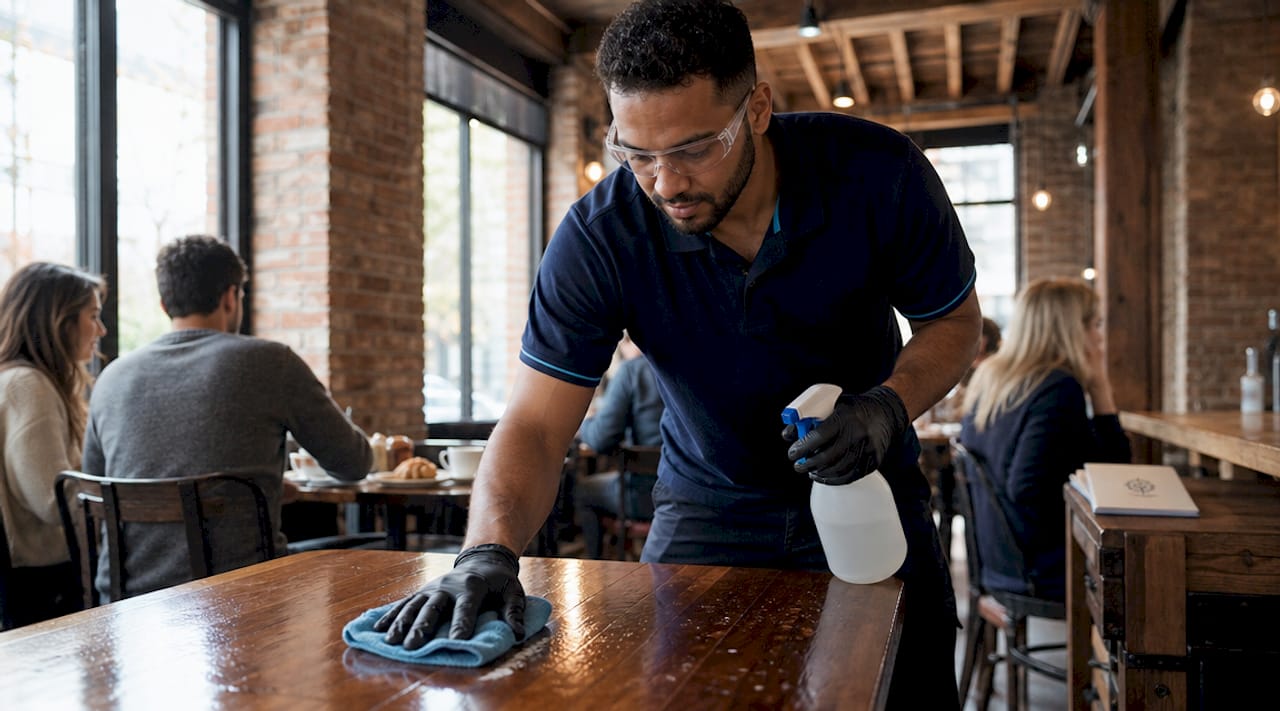
These four terms form the most important hierarchy in cleaning business vocabulary, and they are not interchangeable.
Cleaning is the physical removal of visible soils, dirt, and debris from a surface. It does not kill pathogens. It removes them mechanically, which is why cleaning always precedes sanitizing or disinfecting. Skipping this step reduces the effectiveness of any chemical treatment that follows.
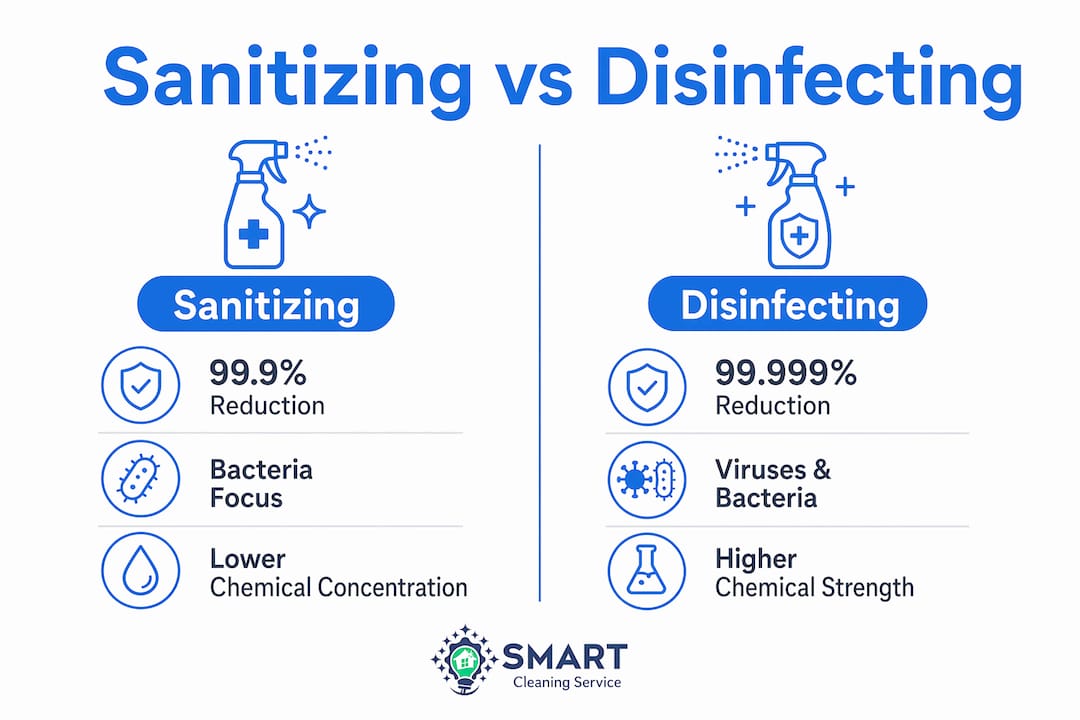
Sanitizing reduces the bacterial load on a surface by 99.9%, which is a 3-log reduction. Disinfecting goes further, achieving a 99.999% bacterial reduction, a 5-log reduction, and it targets a broader range of pathogens including viruses and fungi. Sterilizing eliminates all microbial life completely and is typically reserved for medical and laboratory settings, not residential or commercial cleaning. These definitions come directly from EPA and FDA standards, which means they are not marketing language. They are regulatory benchmarks.
| Term | Microbial reduction | Typical application |
|---|---|---|
| Cleaning | Physical removal only | All surfaces before treatment |
| Sanitizing | 99.9% (3-log) bacteria | Food prep areas, kitchens |
| Disinfecting | 99.999% (5-log) bacteria + viruses | Bathrooms, healthcare settings |
| Sterilizing | 100% elimination | Medical and lab environments |
Why does this matter for you? If a cleaning company tells you they “disinfect” every surface during a standard visit, ask which EPA-registered product they use and at what dwell time. Disinfection requires a specific contact time on the surface to reach the 5-log threshold. A quick wipe does not qualify.
Pro Tip: When reviewing a cleaning contract, check whether it specifies “sanitizing” or “disinfecting.” These are different service levels with different product requirements and different costs. Never assume one implies the other.
How do cleaning strategies differ: routine, interim, restorative, and deep cleaning?
Cleaning strategies are defined by soil condition and required intensity, not by the equipment used or the brand of product applied. This is one of the most clarifying ideas in modern cleaning industry concepts, and it comes from the framework developed by floor care professionals who recognized that cleaning is an event, while maintenance is a system.
Here is how the four primary strategies break down:
- Routine cleaning covers vacuuming, spot removal, and mechanical entrainment to address dry soils and surface-level contamination. Mechanical entrainment uses counter-rotating brushes or agitation tools to dislodge embedded particles, reset pile structure in carpets, and improve chemical distribution. It goes well beyond what a standard vacuum pass achieves.
- Interim cleaning targets soluble soils and binding agents that routine cleaning cannot remove. It is defined by intent and intensity, not by moisture level alone. A low-moisture encapsulation treatment and a light extraction pass can both qualify as interim cleaning depending on the soil load.
- Restorative cleaning addresses abnormal conditions: flooding, fire residue, severe neglect, or biological contamination. It is situation-dependent, not a scheduled service. Calling in a restorative clean does not mean the maintenance program failed. It means an event occurred that exceeded normal soil parameters.
- Deep cleaning is the most contested term in the industry. It can refer to health-based particulate reduction, a scheduled intensive service, or a marketing claim based on wastewater visibility. When a company shows you dark extraction water as proof of effectiveness, that is marketing, not measurement. True deep cleaning is defined by what is removed from the surface, not what ends up in the tank.
Pro Tip: Before booking a “deep clean,” ask the provider to define it in writing. A reputable company will describe the specific tasks, soil targets, and products used. Vague answers are a red flag.
The practical takeaway for property managers and homeowners is this: build a maintenance system using routine and interim cleaning on a schedule, and reserve restorative cleaning for genuine need. You can explore how cleaning frequency directly affects long-term surface health and indoor air quality.
What are common cleaning product and service terms every stakeholder should know?
Cleaning product terms like abrasive, antimicrobial, encapsulation, and low-pH cleaner define how a product acts on a surface. Knowing these terms helps you ask better questions and avoid surface damage.
Product terminology you need to recognize
Abrasive cleaners use physical particles to scour surfaces. They are effective on hard mineral deposits but will scratch soft surfaces like acrylic or polished stone. Antimicrobial products inhibit or kill microorganisms and must carry an EPA registration number to make that claim legally. Encapsulation chemistry surrounds soil particles in a crystalline polymer that releases from the surface when dry, making it ideal for interim carpet maintenance without over-wetting. Low-pH cleaners are acidic and effective on mineral scale, rust, and hard water deposits. High-pH or alkaline cleaners cut through grease and organic soils. Using the wrong pH on the wrong surface is a common cause of damage that voids manufacturer warranties.
HEPA filtration in vacuums captures particles as small as 0.3 microns at 99.97% efficiency. For anyone managing a property where occupant health is a priority, HEPA-rated equipment is not optional. It is the standard.
Service type definitions that affect your contract
| Service type | Definition | Typical use case |
|---|---|---|
| Janitorial | Ongoing, scheduled maintenance cleaning | Office buildings, commercial spaces |
| Commercial cleaning | Broader term covering janitorial plus specialty services | Retail, medical, industrial |
| Residential cleaning | Scheduled home cleaning, recurring or one-time | Houses, condos, apartments |
| Turnover cleaning | Full reset between occupants | Airbnb, short-term rentals |
| Move-in/move-out cleaning | Deep-level cleaning at tenancy transitions | Rental properties |
Service type terms like turnover cleaning and move-in/out cleaning have specific operational definitions that vary by platform and local custom. An Airbnb host who books a “standard clean” when they need a “turnover clean” will get a different result than expected, and the gap between those two outcomes is often a negative review.
How does understanding cleaning terminology prevent issues and protect warranties?
Misinterpreting cleaning terms can void equipment or surface manufacturer warranties and lead to service gaps that cost significantly more to correct later. This is not a theoretical risk. It is a documented pattern in the industry.
Here is how terminology knowledge protects you in practice:
- Read your flooring warranty before booking any service. Most carpet and hard floor warranties specify approved cleaning methods by category, not by brand. A warranty that requires “hot water extraction” will not cover damage caused by a dry compound method, even if the result looks identical.
- Verify that contract language matches the service delivered. If a contract says “maintenance cleaning” but the scope includes restorative work, the pricing and liability terms may not align. Precise contract language sets clear deliverables and protects both parties.
- Ask for documentation of products used. Trained professionals log the products, dilution rates, and dwell times applied during a service. This documentation matters if a surface issue arises later and a manufacturer asks for service records.
- Understand what “maintenance” means in your agreement. Using “maintenance” incorrectly in a service scope can create ambiguity about whether a provider is responsible for restorative outcomes. Maintenance is a system. It does not guarantee restoration.
Pro Tip: Ask any cleaning provider to walk you through their service scope using the four-tier framework: routine, interim, restorative, and deep cleaning. If they cannot explain the difference, they are likely using those terms interchangeably, which is a sign of inconsistent training.
Understanding what a cleaning guarantee actually covers is equally important. A satisfaction guarantee and a warranty-compliant cleaning process are two different things. Knowing both protects your property and your budget.
Key takeaways
Cleaning industry terminology is a practical tool, not academic vocabulary. Professionals, property managers, and homeowners who master these definitions avoid service mismatches, protect warranties, and communicate with precision.
| Point | Details |
|---|---|
| Sanitizing vs. disinfecting | Sanitizing achieves 99.9% bacterial reduction; disinfecting achieves 99.999%, a critical regulatory difference. |
| Deep cleaning is not standardized | The term can mean health-based, schedule-based, or marketing-based outcomes. Always get a written scope. |
| Cleaning strategies follow soil conditions | Routine, interim, restorative, and deep cleaning are defined by intensity and soil type, not equipment. |
| Product terms affect surface safety | Using the wrong pH cleaner or abrasive can void manufacturer warranties and damage surfaces. |
| Terminology protects contracts | Precise language in service agreements prevents disputes and ensures both parties share the same expectations. |
Why the industry’s language problem is actually your problem too
I have spent years watching the same conversation play out between property owners and cleaning providers. The owner says “deep clean.” The provider hears “thorough standard clean.” The invoice arrives, the owner is disappointed, and the provider is confused. Neither party is dishonest. They just spoke different languages.
What I find most telling is how rarely the confusion gets traced back to terminology. People blame the provider’s effort or the owner’s expectations, when the real issue is that the industry has allowed marketing language to colonize technical vocabulary. “Deep cleaning” is the most obvious example. It has been used to describe everything from a 90-minute apartment reset to a multi-day flood remediation. That range is not a feature. It is a failure of professional communication.
My honest view is that cleaning professionals carry more responsibility here than they typically accept. When you use a term like “disinfecting” to describe a wipe-down with an all-purpose cleaner, you are not just being imprecise. You are potentially misleading a client who is making health decisions based on your claim. The EPA and FDA definitions exist precisely because these distinctions matter.
For homeowners and property managers, the fix is simpler than it sounds. Ask one question before every service: “Can you define what you mean by that in terms of what you will actually do?” A trained professional will answer without hesitation. That answer tells you everything you need to know about the quality of service you are about to receive.
— Wilker
See the difference that precise, professional cleaning makes
At Smartcleaningwa, every service scope is defined before the crew arrives. Whether you need recurring residential cleaning, a move-out deep clean, or an Airbnb turnover in the Greater Seattle Area, the team applies industry-standard terminology to set clear expectations and deliver consistent results. Smartcleaningwa is licensed, insured, and trained to document the products and methods used on every visit. If you want to see how professional residential cleaning applies these standards in practice, explore the full service breakdown. For commercial properties, the commercial cleaning Seattle guide covers service types, scope definitions, and what to expect from a compliant cleaning program.
FAQ
What is the difference between sanitizing and disinfecting?
Sanitizing reduces bacteria by 99.9% (a 3-log reduction), while disinfecting achieves a 99.999% (5-log) reduction and targets a broader range of pathogens including viruses. Both require a clean surface first and an EPA-registered product applied at the correct dwell time.
What does “deep cleaning” actually mean?
The term has no single standardized definition. It can refer to health-based particulate removal, a scheduled intensive service, or a marketing description based on visible wastewater. Always ask a provider to define the specific tasks and soil targets included before booking.
How does cleaning terminology affect warranties?
Most flooring and surface warranties specify approved cleaning methods by category. Using a method not listed, or misrepresenting the service type in documentation, can void coverage. Keeping service records with product names, dilution rates, and methods protects you if a warranty claim arises.
What is the difference between janitorial and commercial cleaning?
Janitorial cleaning refers to ongoing scheduled maintenance in commercial spaces such as offices. Commercial cleaning is a broader category that includes janitorial services plus specialty work like floor stripping, window cleaning, and post-construction cleanup.
Why does sanitation matter beyond just cleaning?
Proper sanitation reduces conditions that attract pests and support pathogen growth. The role of sanitation in pest control shows that consistent sanitizing practices directly reduce infestation risk, making it a cross-industry concern for property managers and homeowners alike.
Recommended
- Smart Cleaning Service™ House Cleaning Seattle Kirkland Bellevue Redmond
- Smart Cleaning Service™ House Cleaning Seattle Kirkland Bellevue Redmond
- Smart Cleaning Service™ House Cleaning Seattle Kirkland Bellevue Redmond
- Smart Cleaning Service™ House Cleaning Seattle Kirkland Bellevue Redmond