
Maintenance cleaning is defined as the routine, ongoing process of cleaning a home or rented space on a regular schedule to preserve hygiene, prevent dirt buildup, and protect surfaces from premature wear. Unlike a one-time scrub-down, this is the weekly or monthly upkeep that keeps your home consistently livable rather than periodically rescued. The industry also calls this “regular cleaning” or “routine cleaning,” and the distinction matters because it shapes how you plan, budget, and prioritize your home care. Done right, maintenance cleaning saves money, protects your health, and extends the life of your floors, appliances, and fixtures. Skipping it, even briefly, creates a compounding problem that costs far more to fix.
What is maintenance cleaning and what tasks does it include?
Maintenance cleaning covers the recurring tasks that address visible dirt and high-touch surfaces before grime has a chance to set in. Routine cleaning focuses on high-traffic, high-use areas rather than attempting to reach every hidden corner on every visit. This targeted approach is what makes it sustainable as a weekly or biweekly habit.
Common maintenance cleaning tasks include:
- Vacuuming carpets, rugs, and hard floors to remove abrasive grit that wears down fibers and finishes
- Mopping hard floors with an appropriate cleaner for the surface type
- Dusting furniture, shelves, ceiling fans, and light fixtures
- Wiping down kitchen counters, stovetops, and appliance exteriors
- Sanitizing bathroom surfaces including sinks, toilets, tubs, and faucet handles
- Emptying trash cans in every room
- Cleaning mirrors and glass surfaces
- Spot-cleaning walls and baseboards in high-traffic zones
Frequency depends on your household. A single person in a one-bedroom apartment may clean every two weeks without issue. A family of four with pets and young children likely needs weekly attention in the kitchen and bathrooms. The goal is to stay ahead of buildup, not to achieve perfection on every visit.
Pro Tip: Rank your rooms by traffic and use that list to set your cleaning priority order. Kitchens and bathrooms always go first because they accumulate bacteria fastest. Bedrooms and living rooms can rotate on a slightly longer cycle without visible consequence.

One point that surprises many homeowners: maintenance cleaning requires a baseline deep clean first. If a space has accumulated months of grime, routine cleaning cannot maintain what has not yet been restored. Starting from a clean baseline is what makes the ongoing routine actually work.
How does maintenance cleaning differ from deep cleaning?
The confusion between maintenance cleaning and deep cleaning is common, and the difference is not just about how long it takes. It is about scope, frequency, and purpose.
Maintenance cleaning is designed for efficiency. It targets what you can see and what gets dirty fastest. Deep cleaning is intensive and periodic. It addresses buildup behind appliances, inside ovens, grout lines, window tracks, baseboards, and areas that routine visits skip entirely. Janitorial maintenance follows a similar ongoing model but is primarily designed for commercial spaces, though the task overlap with residential routine cleaning is significant.
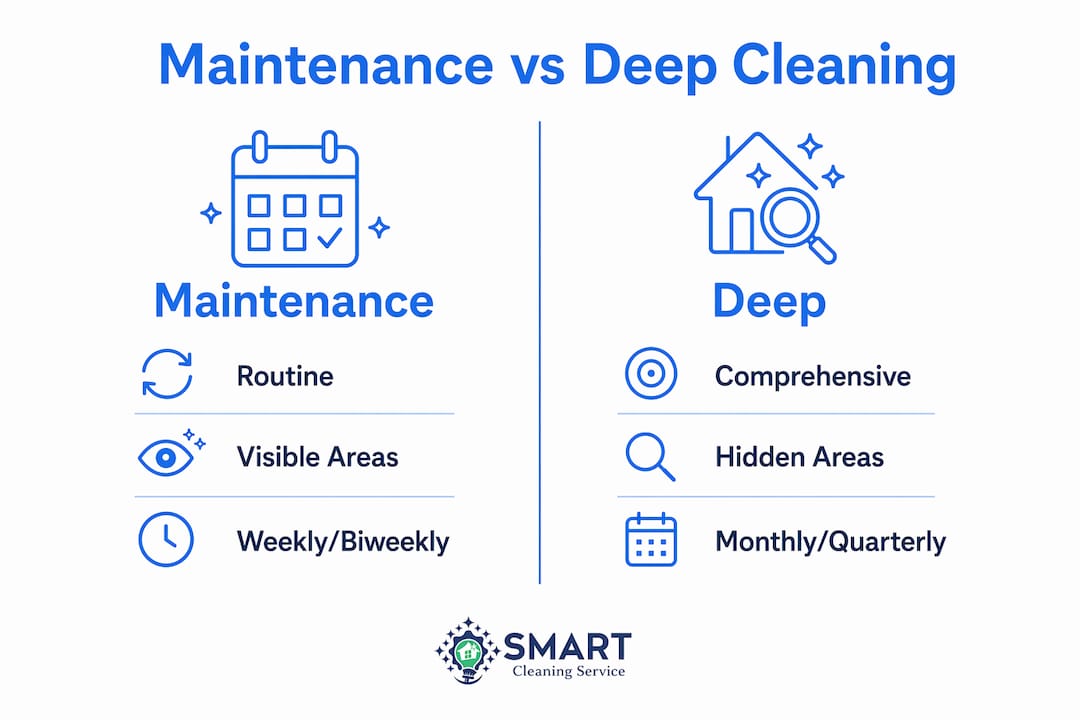
Here is how the three approaches compare:
| Type | Frequency | Scope | Primary goal |
|---|---|---|---|
| Maintenance cleaning | Weekly or biweekly | High-traffic, visible surfaces | Prevent buildup and maintain hygiene |
| Deep cleaning | Every 3 to 6 months | All surfaces including hidden areas | Restore cleanliness baseline |
| Janitorial cleaning | Daily to weekly | Commercial spaces, common areas | Keep facilities sanitary and presentable |
The relationship between maintenance and deep cleaning is sequential, not competitive. A deep clean your house session sets the baseline, and routine maintenance preserves it. Skipping routine cleaning forces more frequent and more expensive deep cleans. Skipping maintenance entirely makes subsequent deep cleaning sessions significantly more difficult, time-consuming, and costly.
The practical takeaway: both types belong in your home care calendar. Deep cleaning is not a substitute for regular upkeep, and regular upkeep cannot replace a thorough periodic reset.
Why is maintenance cleaning important for homeowners and renters?
The importance of maintenance cleaning goes well beyond appearances. Three concrete benefits drive the case for consistency: health protection, cost savings, and asset longevity.
Health protection
Routine cleaning directly reduces exposure to germs, allergens, and airborne particles. A consistent cleaning program combining surface disinfection and hand hygiene produces a 50% reduction in sickness absence among occupants. That figure comes from workplace research, but the biology applies equally at home. Dust mites, mold spores, pet dander, and bacteria accumulate on surfaces within days of the last clean. Regular carpet cleaning, for example, removes allergens that degrade indoor air quality and trigger respiratory symptoms. For households with children, elderly residents, or anyone with allergies or asthma, consistent upkeep is a direct health intervention.
Cost savings
The financial argument for routine cleaning is straightforward. Emergency repairs from neglected maintenance cost 50 to 100% more than planned upkeep, and reactive cleaning or repairs cost 3 to 10 times more than scheduled proactive cleaning. A grout line that gets scrubbed monthly stays intact. One that goes two years without attention may need professional restoration or full retiling. The same logic applies to stovetop grates, bathroom caulk, and hardwood floors.
Asset longevity
Consistent removal of abrasive particles like grit and dust extends the lifespan of floors and fixtures by preventing premature wear. Grit tracked in from outside acts like sandpaper on hardwood and tile. Grease left on kitchen surfaces degrades finishes over time. Cleaning is a form of asset management that actively prevents deterioration rather than simply making a space look presentable.
Pro Tip: Schedule your maintenance cleaning on a fixed day each week or every two weeks and treat it like a utility bill. Consistency is what generates the health and cost benefits. Sporadic cleaning does not compound the same way.
How to build an effective maintenance cleaning routine
Setting up a routine that actually holds requires more than good intentions. It requires a realistic schedule, the right tools, and a system for staying consistent when life gets busy.
Step-by-step setup
- Start with a baseline deep clean. Before any routine can work, the space needs to be at a clean starting point. This is non-negotiable.
- Map your space by traffic level. Identify which rooms get the most use. Kitchen, bathrooms, and entryways need the most frequent attention.
- Choose your frequency. Weekly works for most active households. Biweekly suits smaller or less-used spaces. Monthly is appropriate only for low-traffic rooms or supplemental tasks like dusting ceiling fans.
- Build a room-by-room checklist. A written checklist prevents missed spots and reduces decision fatigue. Apps like Tody or a simple printed sheet both work.
- Gather your tools once. A quality vacuum, a microfiber mop, an all-purpose cleaner, microfiber cloths, a toilet brush, and a scrub sponge cover the majority of routine tasks. Avoid accumulating products you will never use.
- Assign tasks if you share the space. Shared households benefit from clear ownership. Ambiguity about who cleans what is the most common reason routines collapse.
- Evaluate every month. If a task consistently gets skipped, either adjust the frequency or consider whether a professional service makes more sense for that area.
Professional maintenance cleaning services are worth considering for households where time is the limiting factor. A recurring service from a licensed, insured company handles the consistency problem entirely and often catches areas that self-cleaning routines miss. For renters, professional cleaning also protects the security deposit by keeping the unit in documented good condition throughout the tenancy.
Pro Tip: If you hire a professional cleaning service, ask them to use a checklist and share it with you after each visit. Real-time documentation tells you exactly what was done and flags anything that needs extra attention before your next session.
Air quality is another dimension of how to maintain cleanliness that often gets overlooked. Air duct cleaning removes accumulated dust and debris from your HVAC system, which recirculates through every room. Pairing duct maintenance with your surface cleaning routine produces measurably cleaner indoor air.
Key takeaways
Maintenance cleaning is the most cost-effective form of home care because it prevents the expensive buildup that forces deep cleaning, repairs, and replacements.
| Point | Details |
|---|---|
| Definition and schedule | Maintenance cleaning is routine upkeep performed weekly or biweekly to maintain hygiene and prevent buildup. |
| Baseline requirement | A deep clean must precede any maintenance routine to establish a clean starting point. |
| Health impact | Consistent cleaning programs reduce occupant sickness by up to 50%, based on 2026 findings. |
| Cost protection | Reactive repairs cost 3 to 10 times more than proactive scheduled cleaning. |
| Asset preservation | Regular removal of grit and dust prevents premature wear on floors, fixtures, and surfaces. |
Why I think most people misunderstand what maintenance cleaning actually is
People treat maintenance cleaning as a chore to minimize. Get it done fast, skip what you cannot see, and move on. That mindset is exactly why so many homes end up needing expensive deep cleans or repairs that could have been avoided entirely.
What I have seen, working with homeowners and renters across different living situations, is that the people who get the most out of their homes treat cleaning the same way they treat oil changes. Not glamorous, not optional, and not something you defer until something breaks. The homes that stay in the best condition are not the ones that get scrubbed hardest twice a year. They are the ones that get consistent, focused attention every week or two.
The other thing most articles get wrong: they treat deep cleaning and maintenance cleaning as competing options. They are not. Professional cleaners protect your home most effectively when both types are in the calendar. The deep clean resets the baseline. The maintenance routine holds it. Without both, you are either over-cleaning or under-cleaning, and neither extreme is efficient.
The mindset shift that actually changes behavior is this: stop thinking of cleaning as restoring order and start thinking of it as preventing disorder. That reframe turns a reactive chore into a proactive habit. And proactive habits compound. A home that gets consistent maintenance cleaning is healthier, cheaper to maintain, and more comfortable to live in. That is not a theory. It is what the data on sickness rates, repair costs, and surface wear consistently shows.
— Wilker
Keep your home consistently clean with Smartcleaningwa
Smartcleaningwa provides recurring residential cleaning for homeowners and renters across the Greater Seattle Area, including Seattle, Bellevue, and Kirkland. Every visit follows a detailed checklist, and you receive real-time updates so you always know what was cleaned and when. Whether you need weekly upkeep, biweekly maintenance, or a one-time deep clean to establish your baseline, Smartcleaningwa’s licensed and insured team delivers consistent, high-quality results. Explore Seattle residential cleaning options or contact us directly for a customized cleaning plan built around your home and schedule.
FAQ
What is the maintenance cleaning definition?
Maintenance cleaning is routine, ongoing cleaning performed on a weekly, biweekly, or monthly schedule to keep a space hygienic and prevent dirt buildup. It focuses on high-traffic, visible surfaces rather than deep or hidden areas.
How is regular cleaning different from deep cleaning?
Regular cleaning maintains a clean baseline through frequent, targeted tasks on visible surfaces. Deep cleaning is an intensive, periodic service that addresses hidden grime, buildup, and areas skipped during routine visits.
How often should homeowners do maintenance cleaning?
Most active households benefit from weekly or biweekly maintenance cleaning. Frequency depends on household size, the presence of pets or children, and how heavily each room is used.
Does maintenance cleaning replace the need for deep cleaning?
No. Maintenance cleaning preserves a clean baseline, but it cannot remove the accumulated grime that builds up in hidden areas over time. A deep clean every three to six months is still necessary for thorough home care.
Can skipping maintenance cleaning cost more in the long run?
Yes. Reactive repairs and cleaning sessions cost 3 to 10 times more than scheduled proactive upkeep. Deferred cleaning also makes subsequent deep cleaning sessions significantly harder and more expensive.
Recommended
- Smart Cleaning Service™ House Cleaning Seattle Kirkland Bellevue Redmond
- Smart Cleaning Service™ House Cleaning Seattle Kirkland Bellevue Redmond
- Smart Cleaning Service™ House Cleaning Seattle Kirkland Bellevue Redmond
- Smart Cleaning Service™ House Cleaning Seattle Kirkland Bellevue Redmond