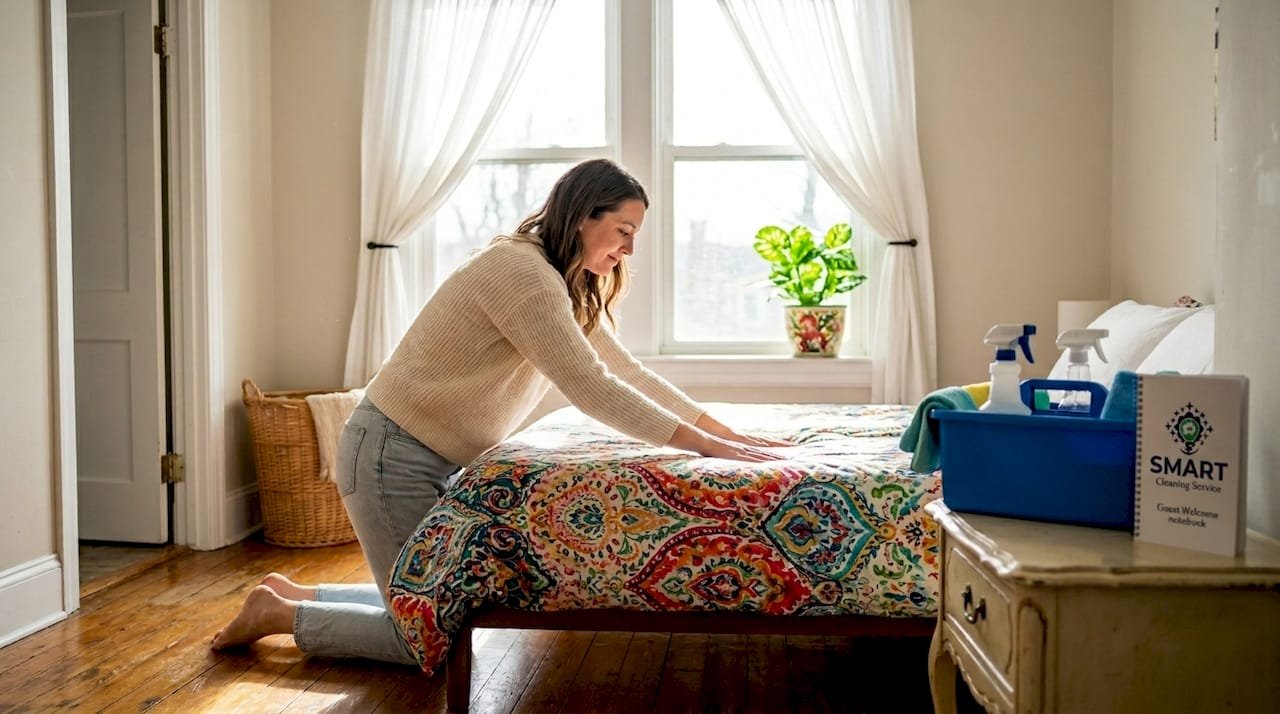
Most hosts discover the hard way that what is housekeeping for Airbnb goes far beyond making beds and wiping counters. Professional Airbnb housekeeping, more accurately called turnover cleaning, is a structured, time-sensitive operation that resets your property between every guest stay. It combines cleaning, restocking, staging, and quality control into a single repeatable workflow. Get it right consistently and your ratings climb. Miss one detail and a guest will mention it in every review they ever write.
Table of Contents
- Key takeaways
- What is housekeeping for Airbnb, exactly?
- The Airbnb turnover cleaning checklist, room by room
- Managing cleaning fees and housekeeping costs
- Operational workflows, restocking, and quality control
- Why treating housekeeping as a system changes everything
- Professional Airbnb turnover services from Smartcleaningwa
- FAQ
Key takeaways
| Point | Details |
|---|---|
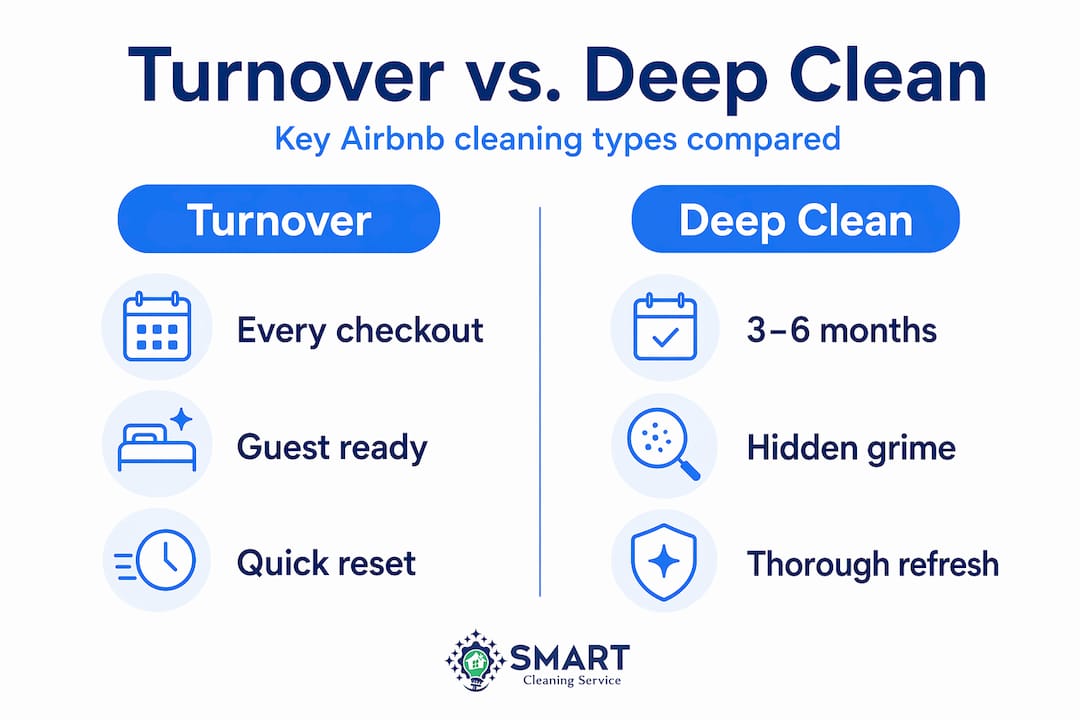
| Turnover vs. deep clean | Turnover cleans reset the property after every stay; deep cleans happen every 3 to 6 months for structural grime. |
| Checklists prevent failures | Room-by-room written checklists catch missed tasks that memory alone will never catch. |
| Fees must cover real costs | Your cleaning fee should reflect actual labor, supplies, and laundry costs or your margin disappears. |
| Photos protect you | Before and after photos verify cleanliness and protect hosts during guest disputes. |
| Workflow order matters | A sequenced, timed workflow prevents recontamination and keeps turnovers on schedule. |
What is housekeeping for Airbnb, exactly?
Airbnb housekeeping is the full operational process of preparing your property for the next guest after every checkout. The industry term for this is turnover cleaning, and it covers far more ground than a standard house clean. A turnover clean focuses on visible surfaces, linens, supplies, and restocking and typically takes one to three hours depending on property size.
The confusion most hosts run into is treating every clean the same. There are actually two distinct cleaning types and mixing them breaks your efficiency and your budget.
Turnover cleaning happens after every single guest checkout. The goal is a complete guest-ready reset within your check-in window. You are not scrubbing behind the refrigerator or cleaning inside the oven every time. You are resetting, restocking, and confirming everything looks and smells fresh for the next arrival.
Deep cleaning is a separate, less frequent operation. Deep cleans occur every 3 to 6 months and target hidden grime, grout, baseboards, window tracks, inside appliances, and any structural buildup that accumulates over time. For properties with high occupancy, some operators schedule a partial deep clean monthly.
Here is a side-by-side comparison to keep both cleans clear:
| Category | Turnover clean | Deep clean |
|---|---|---|
| Frequency | After every checkout | Every 3 to 6 months |
| Time required | 1 to 3 hours | 4 to 8+ hours |
| Focus areas | Linens, surfaces, restocking, staging | Appliances, grout, baseboards, vents |
| Goal | Guest-ready reset | Structural cleanliness and property health |
| Cost | Routine, predictable | Higher, periodic investment |
Pro Tip: Never let a turnover cleaner use deep-clean time during a regular checkout. Reserve that scope for scheduled deep-clean sessions so your turnover stays on time and on budget.
Successful Airbnb operators who treat these as separate, documented workflows consistently outperform hosts who conflate the two.
The Airbnb turnover cleaning checklist, room by room
A written, room-by-room checklist is the single most important tool in Airbnb management cleaning. Memory fails. Checklists do not. Here is how professional housekeeping tasks for Airbnb break down by area:
Master bedroom and all sleeping areas. Strip all linens and pillowcases. Replace with fresh, pressed sets. Check under beds for forgotten guest items. Dust all surfaces, nightstands, lamps, and ceiling fan blades. Confirm the number of pillows and throws matches your staging reference photo.
Bathrooms. Disinfect toilets inside and out, including the base and behind the seat. Scrub sinks and faucets. Clean mirrors without streaks. Wipe shower walls and doors. Restock toilet paper, soap, shampoo, and conditioner to exact quantities. Replace bath mats if damp.
Kitchen. Wipe down all counters and the backsplash. Clean the stovetop and check the inside of the microwave. A practical turnover checklist includes cleaning the refrigerator interior every turnover, not just periodically. Empty the trash. Run a dishwasher cycle if dishes were left. Restock coffee pods, paper towels, dish soap, and any welcome supplies.
Living areas. Vacuum all upholstered furniture. Fluff and reposition cushions. Wipe remotes, light switches, and door handles with a disinfectant wipe. These high-touch surfaces carry more bacteria than most visible surfaces and guests notice if they feel sticky.
Floors throughout. Vacuum first, then mop. Doing it in the opposite order just redistributes debris. Pay attention to corners and under furniture edges.
Final staging and supply restock. Return all decor to positions shown in your property reference photos. Verify that every consumable matches your per-property inventory list. Small restocking errors like missing coffee pods or toilet paper drive guest dissatisfaction more than almost any other oversight.
Pro Tip: Take a reference photo of every room in its staged state and share it with your cleaning team. Cleaners can match the photo exactly rather than guessing your setup preferences.
Managing cleaning fees and housekeeping costs
Pricing your cleaning fee correctly is one of the most misunderstood parts of running an Airbnb. Too low and you subsidize every guest stay out of your own pocket. Too high and your booking conversion drops.
Average US hourly rates for Airbnb cleaning services run about $30, with a range of $20 to $90 depending on your market, property size, and the scope of the service. Laundry, deep cleaning tasks, and restocking all raise the total cost beyond the base hourly rate.
Here is what you should factor into your cleaning fee calculation:
- Labor. Base cleaning time multiplied by your cleaner’s rate. A two-bedroom property taking two hours at $35 per hour means $70 in labor before anything else.
- Laundry. Either your cleaner’s time to wash and dry linens on-site, or the cost of a linen service. Do not forget to include this. Many hosts accidentally eat this cost.
- Consumables and restocking. Toilet paper, soap, coffee, paper towels, and any welcome amenities add up. Track your average monthly spend and divide it by the number of turnovers.
- Supplies and equipment. Cleaning products, microfiber cloths, mop heads, and vacuum bags are ongoing costs most hosts forget to account for.
Cleaning fees should reflect actual costs to avoid discouraging bookings. A $200 cleaning fee on a one-night stay will kill conversions even if your nightly rate is fair. Some hosts fold a portion of the cleaning cost into the nightly rate to soften the fee’s visual impact. Both approaches work, but you need to know your actual numbers first.
For hosts managing multiple properties, negotiating a flat per-turnover rate with a cleaning company offers predictability. It also removes the incentive for cleaners to run up hours.
Operational workflows, restocking, and quality control
Knowing what to clean is one thing. Running a reliable, repeatable operation is something else entirely. This is where most hosts who start with informal cleaning arrangements eventually hit a wall.
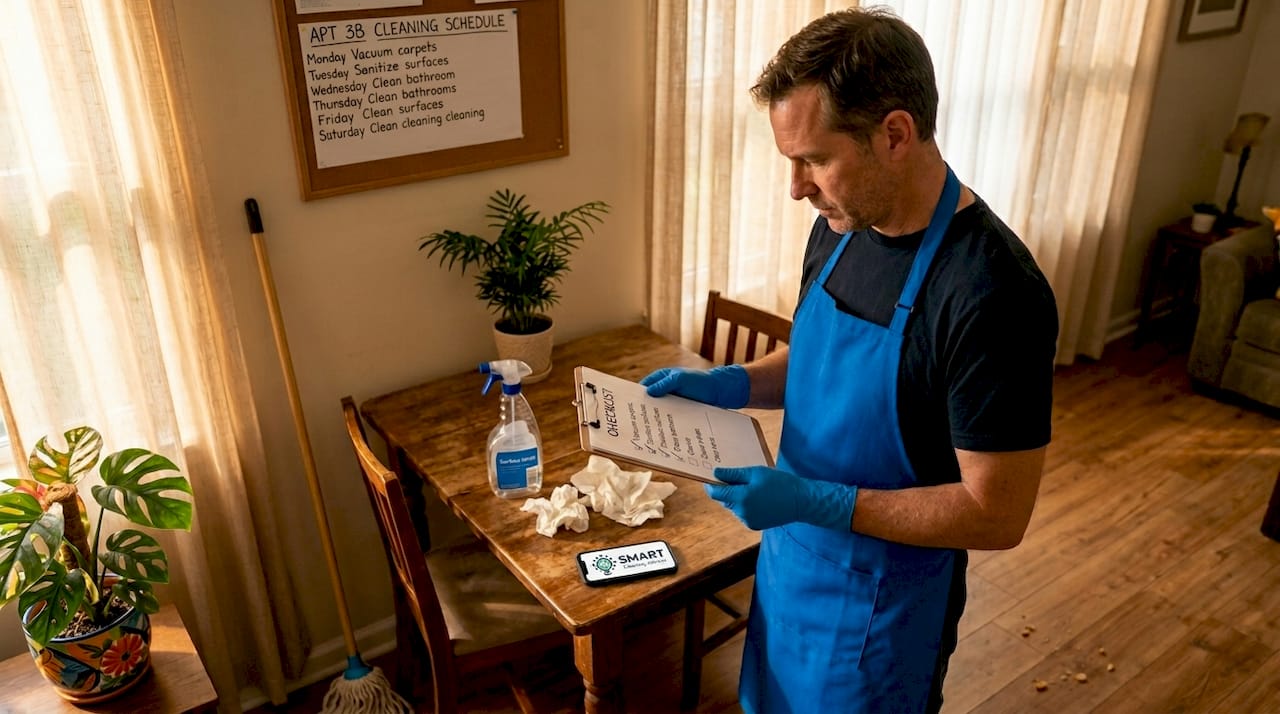
Top Airbnb cleaning operations use a timed, sequenced workflow to prevent recontamination and manage parallel tasks efficiently. Laundry goes in first, before cleaning begins. Cleaning proceeds top to bottom in every room. Restocking and staging happen last, after all cleaning is complete. This sequence matters because dusting while laundry tumbles and dishes air-dry means none of those surfaces are truly clean at the end.
Here is how to organize cleaning teams for a repeatable operation:
- Assign one person to manage laundry from the moment they arrive. Linens in the wash before anything else.
- Cleaners follow a printed checklist specific to that property, not a generic list.
- Each cleaner owns a zone, bathroom, kitchen, bedrooms, so no task gets assumed covered by someone else.
- Restocking is verified against a per-property itemized list, not memory. Per-property itemized SKUs and a final restock verification before lockup are hallmarks of professional operations.
Photo documentation sits at the center of quality control. Photos taken before and after cleaning give hosts visual proof that the property was guest-ready and protect against false damage claims. Keep a shared folder organized by date and property. If a guest claims the unit was dirty on arrival, you have timestamped evidence.
| Quality control tool | Purpose | When to use |
|---|---|---|
| Room reference photos | Confirms staging matches host specs | Every turnover |
| Pre-clean condition photos | Documents guest-caused damage | Immediately after checkout |
| Post-clean verification photos | Confirms property is guest-ready | After cleaning is complete |
| Per-property restock checklist | Prevents supply shortfalls | Final step before locking up |
A final walkthrough by the lead cleaner or property manager closes the loop. This person is not cleaning. They are inspecting, comparing, and signing off. That separation of roles is what professional cleaning workflows look like in practice.
Why treating housekeeping as a system changes everything
I’ve seen the full spectrum of how hosts handle turnovers, from a host texting a friend $50 to “do a quick clean” to properties run with documented workflows, dedicated teams, and photo verification at every stage. The difference in guest review scores is not subtle.
What I’ve found is that most housekeeping failures are not cleaning failures. They are system failures. A host who cleans thoroughly but inconsistently will still collect one-star cleanliness reviews because guests who arrive to find one forgotten coffee ring or a sticky remote do not grade on a curve. They grade on expectation. And Airbnb has trained guests to expect hotel standards.
The uncomfortable truth is this: if your housekeeping relies on anyone’s memory at any stage, it will eventually fail. The hosts I’ve seen scale from one property to five or ten without a collapse in cleanliness ratings are the ones who treated every process like a franchise. Checklists, photos, restocking standards, and a professional cleaning approach applied consistently. Not because they love paperwork, but because they learned that documentation is what makes a system survive a sick cleaner, a last-minute booking, or a 10 a.m. checkout followed by a noon check-in.
Invest in the system before you need it. Once a pattern of poor cleanliness reviews starts, recovering your average rating takes months of perfect turnovers.
— Wilker
Professional Airbnb turnover services from Smartcleaningwa
If building a full housekeeping operation in-house feels like more than you signed up for, that is exactly where Smartcleaningwa comes in. We specialize in Airbnb turnover services for hosts across the Greater Seattle Area, including Kirkland, Bellevue, and Redmond. Our teams work from property-specific checklists, handle restocking, and provide real-time updates so you always know when your property is guest-ready. Whether you need recurring turnovers, a periodic deep clean, or both, we match our service to your schedule and your standards. Reach out to get a custom quote for your property.
FAQ
What does Airbnb housekeeping include?
Airbnb housekeeping covers the full turnover process after a guest checkout, including stripping and replacing linens, cleaning and disinfecting all rooms, restocking supplies, and staging the property for the next arrival. Professional operations also include photo documentation and a final inspection.
How long does a typical Airbnb turnover clean take?
A standard turnover clean takes one to three hours depending on the size of the property and the scope of restocking required. Larger properties or those requiring laundry on-site will take longer.
How much do Airbnb cleaning services cost?
Average hourly rates run about $30 in the US, with a range of $20 to $90 based on property size, location, and service scope. Laundry and restocking add to the total.
How often should Airbnb properties get a deep clean?
Deep cleaning is recommended every three to six months for most properties, though high-occupancy rentals benefit from more frequent deep-clean sessions targeting appliances, grout, and built-up grime.
Should I use a checklist for every Airbnb turnover?
Yes. A written, room-by-room checklist is the most reliable way to maintain consistent cleanliness standards across every turnover, especially when multiple cleaners or a third-party service handles your property.
Recommended
- Smart Cleaning Service™ House Cleaning Seattle Kirkland Bellevue Redmond
- Smart Cleaning Service™ House Cleaning Seattle Kirkland Bellevue Redmond
- Smart Cleaning Service™ House Cleaning Seattle Kirkland Bellevue Redmond
- Smart Cleaning Service™ House Cleaning Seattle Kirkland Bellevue Redmond