Most homeowners assume a weekly wipe-down is enough to keep their space clean and safe. It is not. The importance of detailed cleaning goes far beyond appearances. Indoor air carries pollutants, allergens, and microbial growth that surface cleaning never reaches. What you cannot see is often what causes the most harm, from aggravated allergies to long-term respiratory strain. This article breaks down why detailed cleaning is foundational for home health, what tools and techniques actually work, and how you can build a cleaning routine that makes a measurable difference.
Table of Contents
- Key takeaways
- Why detailed cleaning matters for indoor air quality
- Tools and techniques that make detailed cleaning work
- Humidity control as a cleaning partner
- Real benefits of thorough cleaning for your home
- Common misconceptions that undermine your cleaning efforts
- My take on why shortcuts always cost you more
- Get a truly clean home with Smartcleaningwa
- FAQ
Key takeaways
| Point | Details |
|---|---|
| Surface cleaning is not enough | Pollutants hide in carpets, upholstery, and vents where routine cleaning rarely reaches. |
| HEPA tools change outcomes | Vacuums with HEPA filtration capture 99.97% of fine particles, making a real dent in allergen load. |
| Humidity control amplifies results | Keeping indoor humidity at 40 to 50% kills dust mite populations without additional chemicals. |
| Chemical choice matters | Switching to fragrance-free cleaners cuts indoor VOC levels measurably within two days. |
| Professional deep cleaning multiplies benefits | Expert services address reservoirs most homeowners overlook and extend appliance lifespan. |
Why detailed cleaning matters for indoor air quality
Here is something most people do not expect: indoor air is typically 2 to 5 times more polluted than outdoor air, and in some cases up to 100 times worse. Your home is sealed tightly, which traps pollutants that accumulate in layers over time. Understanding this is the first step toward doing something about it.
The hidden reservoirs are the real problem. Carpets, upholstery, curtains, and HVAC components all act as traps for dust, pet dander, mold spores, and volatile organic compounds (VOCs). A couch that looks clean can hold years’ worth of shed skin cells and allergens. HVAC ductwork circulates whatever accumulates in it every time you turn on the heat or air conditioning.
The role of attention to detail in cleaning is never more obvious than when you look at what standard cleaning misses:
- Carpet fibers trap fine particles below the surface, where vacuuming without proper filtration pushes debris around rather than removing it
- Upholstered furniture collects allergens at concentrations similar to carpeting but gets cleaned far less often
- Kitchen and bathroom vents accumulate grease and mold spores that circulate back into living areas
- Baseboards and ceiling fans collect settled dust that becomes airborne again with any air movement
The EPA identifies source control as the most effective strategy for improving indoor air quality. That means removing pollutants at their origin rather than waiting to filter them after they are already airborne. Detailed cleaning is exactly that: systematic source removal.
Tools and techniques that make detailed cleaning work
Knowing what to clean matters less than knowing how to clean it. The wrong tools redistribute contaminants rather than remove them. Dry dusting and sweeping release settled particles back into the air, increasing occupant exposure temporarily. That is not a minor inconvenience. For someone with asthma or allergies, it can trigger symptoms for hours.
The right equipment changes everything
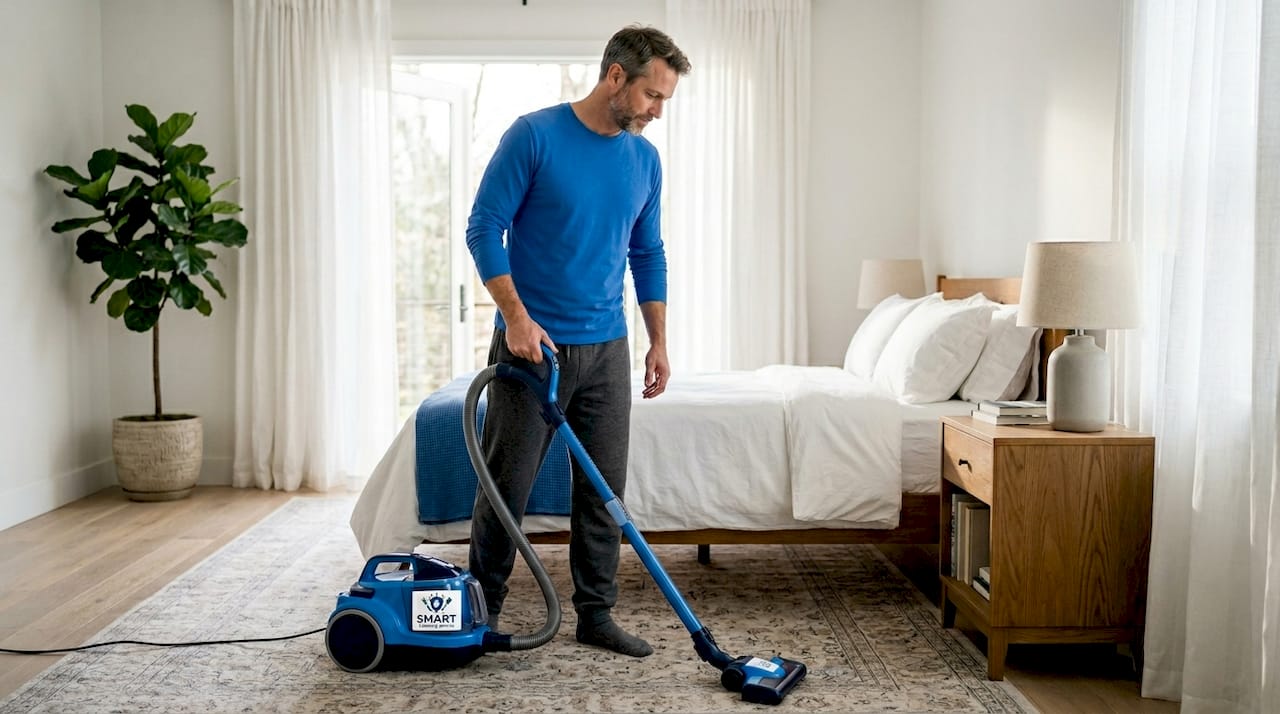
HEPA filters capture 99.97% of particles as small as 0.3 microns. That includes fine dust, mold spores, pet dander, and bacteria. A vacuum without HEPA filtration simply returns these particles through its exhaust. If you are vacuuming with a standard machine, you may be moving the problem more than solving it.
Microfiber cloths work on a similar principle. Their fiber structure physically traps particles rather than pushing them along a surface. A cotton rag dragged across a dusty shelf mostly relocates dust. A microfiber cloth grabs it and holds it until you rinse or wash the cloth.
For floors, damp mopping beats dry sweeping every time. The moisture captures fine particles and prevents them from becoming airborne. This is especially important in kitchens and high-traffic areas.
Here is a breakdown of what detailed cleaning technique requires:
- HEPA filtration vacuum for carpets, rugs, upholstered furniture, and mattresses
- Microfiber cloths for all hard surfaces, wiped damp rather than dry
- Damp mop for hard floors after vacuuming
- Scrubbing attention to grout and caulk in wet areas to prevent mold colonization
- Focused cleaning of high-touch surfaces such as light switches, handles, and remote controls
Pro Tip: Switching to fragrance-free, low-VOC cleaning products can reduce indoor VOC levels by 25% within just 48 hours. Many “clean scent” products contain synthetic fragrances that add to your home’s chemical load rather than reducing it.
You can find specific cleaning techniques that target allergen reservoirs in high-traffic rooms if you want a room-by-room framework to follow.
Humidity control as a cleaning partner
Detailed cleaning removes what is already there. Humidity control prevents new problems from taking hold. These two strategies work together, and skipping one limits the effectiveness of the other.
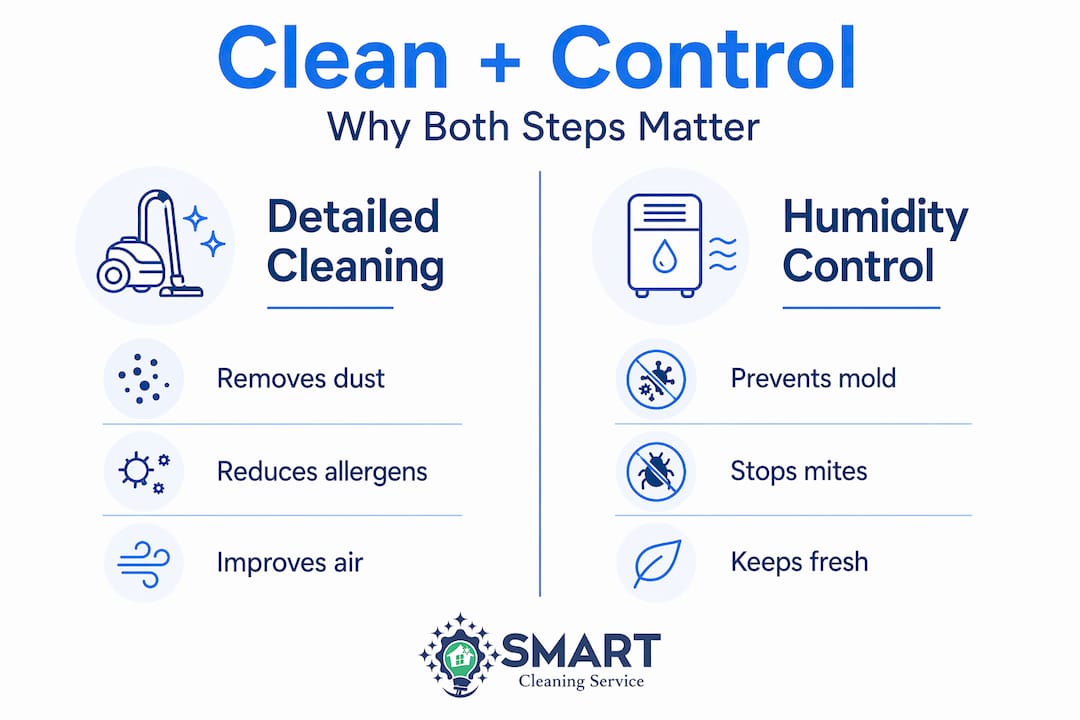
The EPA recommends keeping indoor relative humidity between 30% and 50%. Above 50%, dust mite populations grow rapidly and mold spores find the moisture they need to colonize surfaces. Below 30%, dry air causes skin and respiratory irritation.
The good news is that dust mite populations are genuinely fragile at lower humidity levels. Dust mites collapse within 6 to 11 days when indoor relative humidity stays at or below 50%. You do not need chemical sprays or expensive treatments. A properly set dehumidifier does the job.
Practical ways to keep humidity in the right range include:
- Use a hygrometer to monitor real-time humidity in bedrooms and living areas (basic models cost under $15)
- Run a dehumidifier in basements, bathrooms, or any space prone to moisture accumulation
- Fix leaks and drips promptly because persistent moisture creates mold within 24 to 48 hours
- Ventilate during cooking and showering using exhaust fans to prevent steam from saturating nearby surfaces
Pro Tip: Bedrooms deserve the most attention because the average person spends 7 to 8 hours there daily. A bedroom with humidity above 50% combined with an unprotected mattress is essentially a dust mite habitat. Wash bedding at 60°C to eliminate dust mites effectively, since lower temperatures do not reach the thermal threshold needed for allergen denaturation.
Real benefits of thorough cleaning for your home
The benefits of thorough cleaning extend well beyond the air you breathe, though that alone would be reason enough. The impact of deep cleaning touches your health, your mental state, your appliances, and even your home’s market value.
For allergy and asthma sufferers, the improvement can be dramatic. Targeted cleaning of carpets and upholstery lowers respiratory symptom frequency by reducing allergen load in the spaces where people spend the most time. You do not need to eliminate every allergen. Reducing allergen load significantly improves quality of life for allergy sufferers, which is a more realistic and achievable goal than total eradication.
There is also a mental wellness dimension that often goes unacknowledged. A physically clean environment reduces background cognitive stress. Research on environmental psychology consistently shows that cluttered and dirty spaces increase cortisol levels, while clean spaces support focus and calm. This is not abstract. Walk into a freshly deep-cleaned room and notice how you feel compared to one with visible dust and grime.
What detailed cleaning protects beyond your health
| Area | Without detailed cleaning | With detailed cleaning |
|---|---|---|
| HVAC system | Dust buildup reduces efficiency, raises energy bills | Cleaner components run efficiently, last longer |
| Appliances | Grease and grime cause premature wear | Regular cleaning extends lifespan by years |
| Flooring | Ground-in dirt scratches and degrades surfaces | Surfaces stay protected and presentable |
| Home value | Neglected homes show wear, lower resale appeal | Well-maintained homes command higher offers |
| Respiratory health | Allergen accumulation triggers chronic symptoms | Reduced load means fewer flare-ups |
If you want a practical starting point, the step-by-step deep clean guide from Smartcleaningwa walks through the process room by room with clear priorities.
Common misconceptions that undermine your cleaning efforts
Many homeowners invest time and money into cleaning without realizing they are making mistakes that limit their results. Understanding why detailed cleaning matters also means knowing what not to do.
The biggest misconception is that an air purifier alone can compensate for inadequate cleaning. It cannot. Mechanical filtration cannot capture gaseous VOCs effectively, and relying solely on an air purifier without addressing the source of pollutants leads to premature filter saturation. The hierarchy of air quality management places source control first, ventilation second, and filtration third. Skipping to filtration and expecting it to carry the full load is a losing strategy.
Another common mistake is assuming warm water washes kill dust mites. Dust mites require a temperature of 60°C (140°F) sustained for at least 10 minutes to be effectively eliminated. Most home washing machines on a “warm” cycle fall well short of that threshold. Similarly, many sprays marketed for dust mite control do not reach the conditions needed to neutralize mite allergens.
“Source elimination combined with ventilation and properly sized HEPA filtration forms the most reliable path to a healthy home.” The hierarchy of air purification effectiveness
A third pitfall: using strongly scented cleaners because they smell “fresh and clean.” Synthetic fragrance is one of the more common sources of indoor VOCs. A product that makes your bathroom smell like a pine forest may be adding chemical load to your air rather than improving it. Fragrance-free formulations are not a compromise. They are the smarter choice.
The path forward is an integrated approach: regular detailed cleaning, humidity management, low-chemical products, and strategic ventilation working together.
My take on why shortcuts always cost you more
I’ve spent years watching homeowners underestimate what their homes are actually holding. The conversation usually starts with “I clean regularly,” and ends when someone points a flashlight behind the couch or opens a duct register. The buildup in places people overlook is almost always shocking to them.
What I’ve learned is that the shortcuts that feel like efficiency end up creating bigger problems later. Using a dry mop because it is faster. Skipping the vacuum under the bed because no one looks there. Avoiding the move-out deep clean because the place looks fine to the eye. These decisions compound. Dust does not disappear on its own. Humidity does not regulate itself. Mold does not wait for a convenient time.
In my experience, the homeowners and renters who invest in proper home hygiene practices consistently report fewer sick days, better sleep, and lower anxiety in their living spaces. That is not a coincidence. The air quality research backs it up, and the lived experience reinforces it every time.
The tools matter. The techniques matter. But the commitment to thoroughness is what separates a clean-looking home from a genuinely healthy one. Cleaning is not a chore you get through. It is a practice you invest in.
— Wilker
Get a truly clean home with Smartcleaningwa

If this article made you realize that your current cleaning routine may be leaving significant health risks unaddressed, you are not alone. Most households benefit from at least one professional deep cleaning service per year to reset allergen levels, address overlooked reservoirs, and give your home a genuine baseline to maintain.
Smartcleaningwa serves homeowners and renters throughout the Greater Seattle Area with licensed, insured cleaning professionals who use proper equipment and low-VOC products. Whether you need a one-time deep clean, ongoing regular cleaning, or a move-in and move-out service, every job is completed with the attention to detail that actually protects your health. Get in touch at smartcleaningwa.com to get started.
FAQ
What is detailed cleaning and how is it different from regular cleaning?
Detailed cleaning addresses all surfaces, hidden reservoirs, and high-touch areas that routine cleaning skips, including carpets, upholstery, vents, and grout. Regular cleaning maintains visible tidiness, while detailed cleaning removes the pollutants that accumulate out of sight.
How often should you do a detailed cleaning of your home?
Most homes benefit from a thorough deep clean two to four times per year, with regular detailed attention to high-traffic areas in between. Households with pets, allergies, or young children may need more frequent deep cleaning to keep allergen levels manageable.
Do HEPA vacuums really make a difference?
Yes. HEPA vacuums capture 99.97% of particles as small as 0.3 microns, which includes the fine dust and allergens that standard vacuums exhaust back into the air. For allergy sufferers, switching to HEPA filtration is one of the highest-impact changes you can make.
Can cleaning products make indoor air quality worse?
Absolutely. Many conventional cleaners contain synthetic fragrances and high-VOC solvents that add chemical pollutants to your indoor air. Switching to fragrance-free, low-VOC formulations reduces this load and improves air quality without sacrificing cleaning effectiveness.
Why is indoor air quality worse than outdoor air in many homes?
Homes trap pollutants from cooking, cleaning products, off-gassing materials, and biological sources like dust mites and mold. Without adequate ventilation and detailed source removal through cleaning, these pollutants accumulate to levels far above what outdoor air typically contains.
Recommended
- Smart Cleaning Service™ House Cleaning Seattle Kirkland Bellevue Redmond
- Smart Cleaning Service™ House Cleaning Seattle Kirkland Bellevue Redmond
- Smart Cleaning Service™ House Cleaning Seattle Kirkland Bellevue Redmond
- Smart Cleaning Service™ House Cleaning Seattle Kirkland Bellevue Redmond