Requirements vary with the property, activity and circumstances. Review the applicable requirements with a qualified adviser; a cleaning appointment does not certify legal or regulatory compliance.
Table of Contents
- Defining office cleaning: Beyond surface-level tidiness
- Routine Cleaning Tasks and Priorities
- High-touch hot spots: The office areas you can’t ignore
- Building an effective office cleaning routine
- Why most office cleaning goes wrong, and how to get it right
- How Smart Cleaning WA can help your Seattle office shine
- Frequently asked questions
Key Takeaways
| Point | Details |
|---|---|
| Office cleaning is systematic | It involves structured processes, defined standards, and quality controls beyond simple tidying. |
| Routine surface cleaning | Confirm applicable requirements |
| High-touch surfaces matter most | Routine surface cleaning |
| Quality checks are essential | Consistency relies on documented checklists, tasks, and routine inspections. |
| Customization beats generic plans | Tailor your office cleaning schedule and methods to your space’s unique needs for best results. |
Defining office cleaning: Beyond surface-level tidiness
Walk into most offices and you will notice one of two things: either the space looks generally tidy, or it looks like a disaster. But appearance alone tells you almost nothing about whether that office is actually clean or safe. Real office cleaning involves a lot more than visual inspection.
Requirements vary with the property, activity and circumstances. Review the applicable requirements with a qualified adviser; a cleaning appointment does not certify legal or regulatory compliance.
Here is what professional office cleaning actually covers at a programmatic level:
- Documented SOPs that specify who does what, with which products, in what order
- List the rooms, accessible surfaces and floor areas that need attention. The quote should specify the work and the arrangements for building access.
- Frequency schedules tied to traffic levels and risk (daily, weekly, monthly)
- Quality assurance checks, whether that is an inspection checklist, supervisor walk-through, or client sign-off
- Requirements vary with the property, activity and circumstances. Review the applicable requirements with a qualified adviser; a cleaning appointment does not certify legal or regulatory compliance.
“A cleaning program that looks good on the surface but lacks documented procedures is like a restaurant kitchen that passes a visual inspection but never logs food temperatures. The risk is invisible until something goes wrong.”
The table below shows how typical office cleaning tasks are organized by type and frequency:
| Task | Category | Typical Frequency |
|---|---|---|
| Vacuuming carpets and rugs | Routine cleaning | Daily or 3x per week |
| Mopping hard floors | Routine cleaning | Daily |
| Emptying trash and recycling | Routine cleaning | Daily |
| Routine surface cleaning | Routine surface cleaning | Daily |
| Wiping down desk surfaces | Routine cleaning | Daily |
| Routine surface cleaning | Routine surface cleaning | Daily minimum |
| Cleaning windows and glass | Routine cleaning | Weekly |
| Deep cleaning breakroom appliances | Routine cleaning | Weekly or monthly |
| Routine surface cleaning | Routine surface cleaning | Daily |
For a workplace visit, list the shared areas and accessible surfaces to be cleaned. The cleaning scope, frequency and building access arrangements should be agreed in the quote. Related reading: Cleaning Products and Preferences, office cleaning services overview.
Routine Cleaning Tasks and Priorities
For a workplace visit, list the shared areas and accessible surfaces to be cleaned. The cleaning scope, frequency and building access arrangements should be agreed in the quote.
Dusting can be included for accessible surfaces in the agreed rooms. Point out delicate items, shelves that should be left alone and any areas that need additional attention.
Requirements vary with the property, activity and circumstances. Review the applicable requirements with a qualified adviser; a cleaning appointment does not certify legal or regulatory compliance.
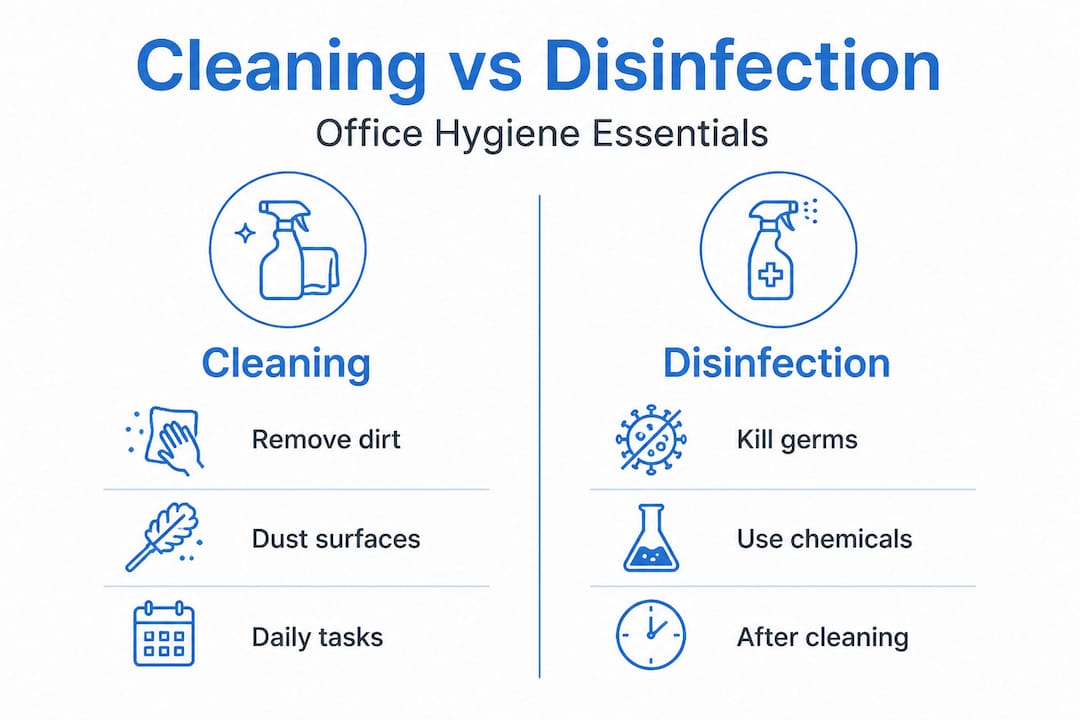
Here is a side-by-side comparison to make this crystal clear:
| Factor | Cleaning | Routine surface cleaning |
|---|---|---|
| Primary goal | Remove dirt and debris | Routine surface cleaning |
| Products used | Soap, detergent, water | Confirm applicable requirements |
| Dwell time required | No | Yes (product-specific) |
| Removes soil | Yes | Not always |
| Routine surface cleaning | Partially (by removal) | Yes (when used correctly) |
| When to prioritize | Daily maintenance, visible dirt | After illness exposure, high-touch zones |
An office cleaning plan can cover common areas, restrooms, breakrooms and floors. Discuss any task outside routine cleaning separately before booking.
Requirements vary with the property, activity and circumstances. Review the applicable requirements with a qualified adviser; a cleaning appointment does not certify legal or regulatory compliance.
Compare estimates by the work listed, team size, minimum charge and billing method. Confirm the scope and any additional charges before the appointment.
Requirements vary with the property, activity and circumstances. Review the applicable requirements with a qualified adviser; a cleaning appointment does not certify legal or regulatory compliance. Related reading: choosing the right cleaning products.
High-touch hot spots: The office areas you can’t ignore
You can have the cleanest floors in Seattle and still have a workplace that spreads illness if you are not paying close attention to high-touch surfaces. These are the areas that dozens or hundreds of hands contact every single day, often without anyone thinking twice about them.
Requirements vary with the property, activity and circumstances. Review the applicable requirements with a qualified adviser; a cleaning appointment does not certify legal or regulatory compliance.
Here is a list of the most commonly neglected high-touch zones in typical Seattle offices:
- Elevator buttons and call panels
- Breakroom appliance touchpoints: microwave buttons, coffee machine handles, refrigerator door handles
- Restroom fixtures: faucet handles, paper towel dispensers, stall latches
- Shared office equipment: printers, copiers, scanners, and their control panels
- Conference room remotes and A/V controls
- Reception area pens, clipboards, and counters
- Keyboard and mouse surfaces on shared or hot-desking workstations
- Chair armrests in waiting areas and conference rooms
- Light switches throughout all common areas
For kitchen work, identify the accessible counters, sink and appliance surfaces to be cleaned. Appliance interiors and other additional tasks should be discussed before the visit.
Choose a visit frequency based on the property, use of the space and tasks you want addressed. Discuss scheduling and the cleaning scope with the office before booking. Related reading: office maintenance routines.
Requirements vary with the property, activity and circumstances. Review the applicable requirements with a qualified adviser; a cleaning appointment does not certify legal or regulatory compliance.
Building an effective office cleaning routine
Now that you understand what needs to be cleaned and how, the next step is organizing all of this into a routine that actually holds together week after week. Consistency is the difference between a cleaning program and a cleaning habit that fades out after a few weeks.
Here is a four-step framework to build or assess your current office cleaning system:
Zone your office space. Divide the office into distinct zones: restrooms, kitchen or breakroom, workstations, conference rooms, reception, and common areas. Each zone has unique risks, traffic levels, and required products. Zoning prevents cross-contamination and makes task assignment clear and logical.
Compare estimates by the work listed, team size, minimum charge and billing method. Confirm the scope and any additional charges before the appointment.
Set task frequency based on actual use and risk. A conference room used twice a week has different needs than a reception desk that handles walk-ins all day. Traffic patterns, shared equipment, and occupancy density should all influence how often each task is done.
Build in quality validation. Documented cleaning standards work best when paired with regular quality checks. This can be a daily supervisor walk-through, a weekly inspection checklist, or a monthly client review. Without validation, even good SOPs drift over time.
Common pitfalls that undermine otherwise solid cleaning programs:
- No written SOPs, which means quality depends entirely on individual habits
- Infrequent or nonexistent quality assurance, so problems accumulate until they become visible
- Failing to update procedures after illness events or layout changes
- Using one-size-fits-all checklists that do not account for your specific space
- An office cleaning plan can cover common areas, restrooms, breakrooms and floors. Discuss any task outside routine cleaning separately before booking.
Pro Tip: When evaluating cleaning service providers, ask to see their actual SOPs and inspection checklists for a space similar to yours. If they cannot produce written documentation, that tells you everything you need to know. Custom systems beat generic templates every single time.
The logistics of scheduling office cleaning also matter. Work with your provider to choose times that minimize disruption, whether that is early morning, evening, or weekends, and confirm that the frequency matches your actual office use patterns.
Why most office cleaning goes wrong, and how to get it right
Discuss floor vacuuming and mopping as part of the visit. Tell the office about the floor material and any manufacturer-specific care instructions.

For a workplace visit, list the shared areas and accessible surfaces to be cleaned. The cleaning scope, frequency and building access arrangements should be agreed in the quote.
Compare estimates by the work listed, team size, minimum charge and billing method. Confirm the scope and any additional charges before the appointment.
Recurring office cleaning can focus on restrooms, breakrooms, accessible surfaces, floor vacuuming and mopping, and trash removal. The quote should identify the areas, priorities and frequency for your workplace.
For Seattle businesses specifically, cookie-cutter cleaning plans are a poor fit. Office layouts, occupancy patterns, and industry-specific risks vary dramatically across neighborhoods and business types. A tech startup in Bellevue with a hot-desking setup needs a different program than a law firm in downtown Seattle with dedicated offices and a formal reception. The right provider organizes cleaning teams to match your actual environment, not to fill a standard template.
Demand customization. Ask questions. Verify the answers in writing.
How Smart Cleaning WA can help your Seattle office shine
Understanding the framework is the first step. The next step is putting it in practice with a provider you can actually trust to follow through.
Choose a visit frequency based on the property, use of the space and tasks you want addressed. Discuss scheduling and the cleaning scope with the office before booking. Related reading: get a cleaning estimate.
Frequently asked questions
What is included in a standard office cleaning service?
Discuss floor vacuuming and mopping as part of the visit. Tell the office about the floor material and any manufacturer-specific care instructions.
Routine Cleaning Tasks and Priorities
Choose a visit frequency based on the property, use of the space and tasks you want addressed. Discuss scheduling and the cleaning scope with the office before booking.
Routine Cleaning Tasks and Priorities
Requirements vary with the property, activity and circumstances. Review the applicable requirements with a qualified adviser; a cleaning appointment does not certify legal or regulatory compliance.
Planning the Cleaning Scope
Quality comes from documented SOPs and checklists combined with regular inspections that verify all tasks were completed correctly and on schedule.
Recommended
- Smart Cleaning Service™ House Cleaning Seattle Kirkland Bellevue Redmond
- Professional Office Cleaning Services in Seattle, WA
- Smart Cleaning Service™ House Cleaning Seattle Kirkland Bellevue Redmond
- Smart Cleaning Service™ House Cleaning Seattle Kirkland Bellevue Redmond