
Most homeowners and property managers in the Greater Seattle Area think about cleaning costs the same way they think about groceries: price per unit. They see an hourly wage or a quoted rate and assume that’s the whole picture. It isn’t. The real costs of keeping cleaning in-house run far deeper, from constant staff turnover and recruiting cycles to liability exposure and inconsistent results that quietly erode your property’s reputation. This article breaks down the true financial and operational case for outsourcing, with local context that matters for Seattle-area property owners.
Table of Contents
- Hidden costs of in-house cleaning
- Outsourcing vs. hiring: A cost comparison
- Quality, reliability and compliance: What you really get
- When outsourcing works best: Real-world scenarios
- The surprising upside most homeowners and managers miss
- Connect with Seattle’s top cleaning professionals
- Frequently asked questions
Key Takeaways
| Point | Details |
|---|---|
| Turnover drives hidden costs | Managing cleaning staff in-house is expensive due to constant staff turnover and replacement costs. |
| Outsourcing saves more long-term | Professional cleaning can be 20–40% cheaper over time when factoring in all expenses. |
| Quality and compliance guaranteed | Professional teams deliver reliable service, handle compliance, and reduce liability—boosting your property value. |
| Strategic value for busy owners | Outsourcing frees up time, improves reputation, and allows property managers to focus on guests and tenants. |
Hidden costs of in-house cleaning
At first glance, hiring a part-time cleaning employee seems straightforward. You pay an hourly rate, you manage the schedule, and you get clean spaces. Simple, right? Not quite. What most property owners discover too late is that the wage line in a spreadsheet represents only a fraction of what in-house cleaning actually costs.
The cleaning and janitorial industry has one of the highest employee turnover rates of any sector. Industry turnover runs 200% annually, meaning many operations replace their entire cleaning staff twice within a single year. Each departure triggers a cycle of advertising, screening, interviewing, onboarding, and training. Those costs add up to $2,000 to $4,000 per replacement on average.
For a property manager overseeing several units in Seattle, that cycle is not a rare disruption. It’s a recurring cost of doing business.
Here’s a quick breakdown of what in-house cleaning truly involves beyond the paycheck:
- Recruiting and job listing fees on platforms like Indeed or ZipRecruiter
- Onboarding time from your own staff or property manager
- Training costs to bring new hires up to your standards
- Supplies and equipment purchased, maintained, and replaced on your dime
- Workers’ compensation, payroll taxes, and benefits that add 20 to 30 percent on top of base wages
- Management overhead spent scheduling, supervising, and correcting work
- Service gaps during transitions, which affect tenant satisfaction
“The most expensive part of in-house cleaning isn’t the mop bucket. It’s the revolving door.”
When a cleaner leaves mid-month, a property doesn’t stop getting dirty. You either scramble to find coverage, do the work yourself, or let the property slip in appearance. For landlords managing multiple units or short-term rentals, a single gap in cleaning service can lead to negative reviews that take months to overcome.
A good way to see this clearly is to look at what a single replacement cycle costs compared to an outsourced contract:
| Cost category | In-house estimate | Outsourced |
|---|---|---|
| Recruiting and hiring | $300 to $800 | $0 |
| Training and onboarding | $500 to $1,200 | $0 |
| Supplies and equipment | $150 to $300/month | Included |
| Payroll taxes and benefits | 20 to 30% of wages | $0 |
| Management overhead | 2 to 5 hrs/month | Minimal |
| Service gap risk | High | Low |
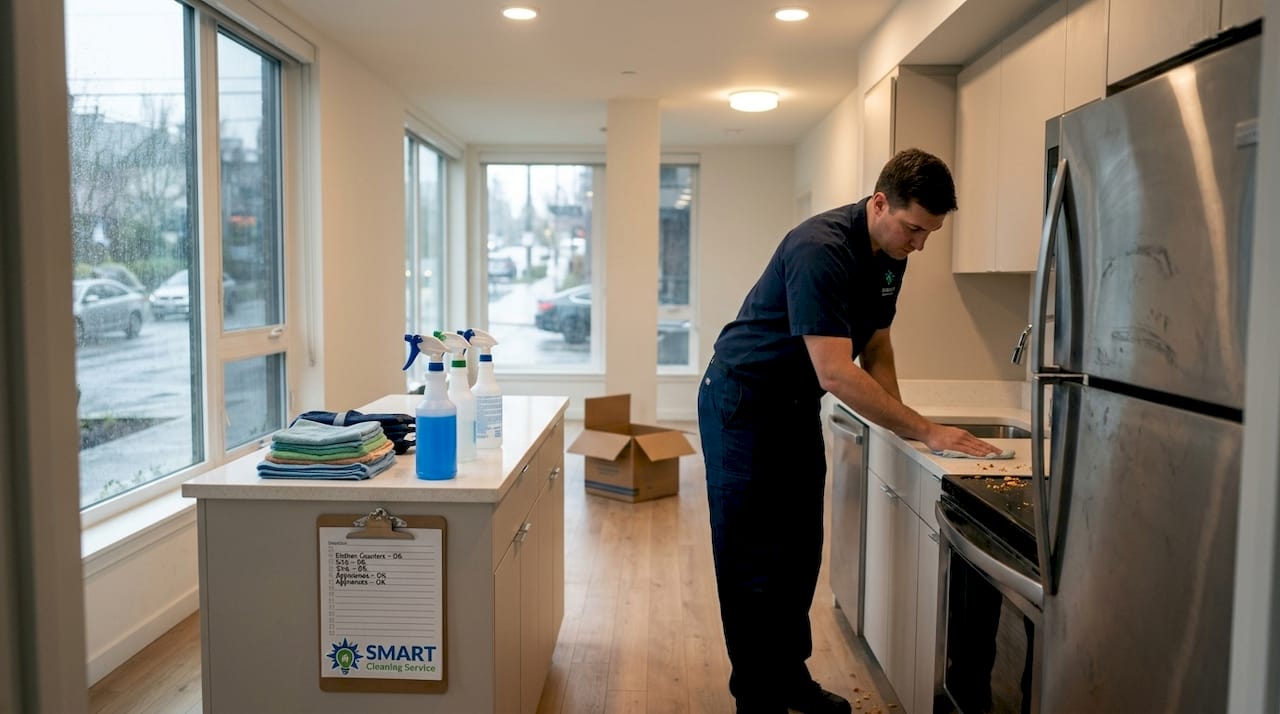
When tenants move out, the stakes for cleaning quality are especially high. A poorly cleaned unit delays re-rental and risks deposit disputes. Following a solid move out cleaning checklist helps, but only if the person doing the work is trained, reliable, and consistent. That reliability is hard to guarantee with in-house staff.
Outsourcing vs. hiring: A cost comparison
Now that you can see the hidden costs stacking up on the in-house side, the comparison with outsourcing becomes much clearer. The key distinction is total cost of ownership rather than hourly rate.
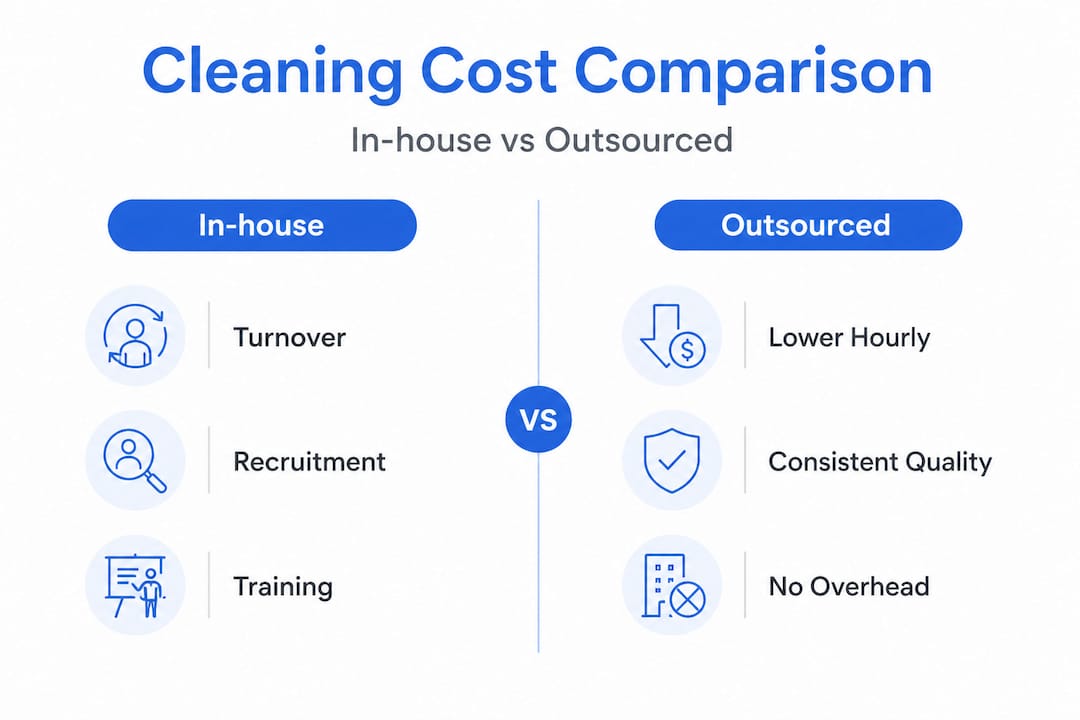
Many property managers see a professional cleaning quote and compare it to a cleaner’s hourly wage. That comparison is misleading. The hourly wage doesn’t include taxes, benefits, turnover costs, equipment, supplies, or your own time managing the person. When you factor all of that in, outsourcing runs 20 to 40% cheaper over the long term according to IFMA and ISSA industry benchmarks.
Here’s a direct comparison for a typical Seattle rental property manager:
| Factor | In-house team | Outsourced service |
|---|---|---|
| True hourly cost (with overhead) | $22 to $35/hr | $18 to $28/hr |
| Turnover costs (annual) | $4,000 to $12,000 | $0 |
| Equipment and supplies | Owner’s expense | Provider’s expense |
| Compliance and insurance | Owner’s liability | Provider’s liability |
| Consistency across locations | Variable | Standardized |
| Flexibility for urgent requests | Limited | Built-in |
Pro Tip: When evaluating cleaning proposals, always ask for a total cost breakdown, not just the rate per hour or per visit. Ask about insurance coverage, what supplies are included, and what happens if a scheduled cleaner is unavailable. These questions will quickly reveal whether you’re comparing apples to apples.
For Seattle property managers with multiple locations, consistency is arguably the biggest advantage. When you work with a professional service for deep cleaning in Seattle, you get the same standards applied across every property, every time. That uniformity protects your brand, your reviews, and your ability to command competitive rental rates.
Consistent cleaning also affects occupancy directly. Properties that are reliably well-maintained attract better tenants and retain them longer. Tenants who feel their living environment is cared for are more likely to renew leases and less likely to file complaints or cause friction. A Seattle home cleaning guide gives homeowners a strong baseline, but keeping up with it week after week is where a regular cleaning schedule from a professional service pays for itself.
Quality, reliability and compliance: What you really get
Cost savings are compelling, but they’re not the only reason to outsource. The quality and reliability gap between in-house and professional cleaning services is significant, especially for high-value properties or those serving multiple tenants.
When you hire a professional cleaning company, you’re not just paying for cleaned surfaces. You’re paying for a trained workforce, standardized cleaning protocols, commercial-grade equipment, and accountability. Here’s what that looks like in practice:
- Trained specialists: Professional cleaners go through structured onboarding that covers surface-specific techniques, product safety, and client expectations. There’s no learning curve on your property.
- Standardized checklists: Every visit follows a set protocol, so nothing gets skipped or forgotten based on who shows up that day.
- Insurance and liability coverage: Reputable cleaning companies carry general liability and workers’ compensation insurance. If something breaks or someone gets hurt on your property during a cleaning visit, that risk stays with the provider, not with you.
- Backup coverage: If your assigned cleaner is sick or unavailable, the company sends a replacement. Your service doesn’t stop. This is a critical differentiator from hiring one or two in-house staff members.
- Real-time communication: Many professional services now offer real-time updates on job completion, photos of the finished space, and direct lines of contact for urgent requests.
The turnover problem that plagues in-house teams simply doesn’t touch you when you outsource. The provider manages all of that internally. If a cleaner leaves their company, the company handles recruiting, training, and coverage. You never feel it.
“With in-house cleaning, you manage a person. With outsourced cleaning, you manage a result.”
For Seattle landlords handling move-in and move-out cleaning, professional services bring a level of detail and documentation that protects both landlord and tenant. This is also where cleaning directly supports tenant satisfaction and property value, not just in the short term but across the lifecycle of your investment.
Pro Tip: Before signing any cleaning contract, confirm that the company is licensed, bonded, and insured in Washington State. Ask for a certificate of insurance and check that it covers your specific property type, whether residential or commercial.
When outsourcing works best: Real-world scenarios
Let’s make this concrete with practical scenarios that reflect what Seattle property owners actually deal with.
Apartment turnovers and move-outs: In Seattle’s competitive rental market, vacancy time is expensive. A professional team can turn a vacated unit in a single day, ensuring it’s spotless and photo-ready for new listings. They follow a detailed checklist, handle appliances, clean grout, and sanitize every surface. That speed and thoroughness is nearly impossible to replicate with a single in-house hire.
Short-term and Airbnb rentals: Hosting in Seattle means managing rapid back-to-back turnovers, sometimes with only a few hours between guests. A missed clean or a skipped bathroom can mean a one-star review. Professional cleaning teams bring speed, consistency, and the ability to flag maintenance issues before the next guest arrives.
Multi-location property management: If you manage five or fifteen units across Seattle, Bellevue, or Kirkland, keeping cleaning standards consistent across all of them using in-house staff is a scheduling and management challenge. A professional service applies the same protocols everywhere, making it easier to maintain your reputation across the portfolio. IFMA and ISSA data confirm that standardized outsourced cleaning consistently outperforms fragmented in-house approaches in multi-site settings.
Deep or specialized cleaning: Whether it’s post-renovation cleanup, seasonal deep cleaning, or a thorough sanitization after a long-term tenant moves out, these jobs require tools and expertise that most in-house staff don’t have. Professional teams come equipped and trained.
Homeowners with busy schedules: Seattle professionals with demanding jobs and full home lives often find that regular cleaning falls through the cracks. The result is that cleaning becomes a stressful weekend task rather than a maintained habit. Scheduling a professional cleaning service in Seattle removes that burden entirely and ensures you always come home to a clean space.
Emergency and seasonal needs: Whether a pipe burst, a party left a mess, or the Pacific Northwest fall brought in mud and moisture, professional cleaners respond quickly. Seasonal challenges like Seattle’s wet winters create ongoing demands for entryway, carpet, and bathroom cleaning that a flexible outsourced arrangement handles better than a fixed in-house schedule. Understanding kitchen cleaning specifics for Seattle homes is one example of where local expertise genuinely matters.
The surprising upside most homeowners and managers miss
Here’s something most cost-comparison articles don’t tell you: the biggest benefit of outsourcing cleaning isn’t the money you save. It’s the mental bandwidth you reclaim.
Property managers and homeowners who switch to professional cleaning services often report that the relief they feel isn’t about the invoice. It’s about no longer carrying the low-level, persistent stress of wondering whether the cleaning got done, done right, and done consistently. That kind of background noise is exhausting, and most people don’t realize how much it drains their focus until it’s gone.
Think about what you could do with the two to five hours per month you currently spend managing cleaning logistics, handling complaints from tenants about unclean spaces, or scrambling to cover for a missing staff member. That time can go toward guest relations, maintenance planning, new property research, or simply not working on weekends.
There’s also a strategic reframe worth considering. Most people treat cleaning as a reactive task. Something gets dirty, you clean it. A tenant complains, you act. But the most successful property managers and homeowners treat cleaning as a proactive investment. A consistently clean property holds its value better, attracts better tenants, earns better reviews, and reduces wear and tear over time because mold, grime, and neglect are caught early.
In Seattle specifically, the local climate adds a layer of complexity that makes this even more relevant. Wet winters, muddy entryways, and damp conditions in bathrooms create faster buildup of mold, mildew, and surface damage than in drier climates. A professional team that understands the Pacific Northwest environment will catch these issues early and address them before they become expensive problems.
For homeowners managing their own Airbnb or rental space, keeping your apartment clean and organized matters for both guest experience and your own sanity. And if you’re growing into a short-term rental portfolio, learning to organize cleaning teams efficiently becomes a genuine operational skill. Outsourcing is usually the smartest first step in building that infrastructure.
Connect with Seattle’s top cleaning professionals
If you’ve been managing cleaning in-house and wondering why it always feels harder than it should, the answer is usually in what you haven’t been able to see: the turnover costs, the liability exposure, the service gaps, and the time you’re spending managing instead of growing.
Smart Cleaning Service works with homeowners and property managers across the Greater Seattle Area to deliver reliable, high-quality cleaning on every visit. Whether you need recurring service, a one-time deep clean, or expert move-in and move-out support, we’re built for the demands of Seattle properties. Understanding how professional cleaning transforms homes is the first step, and seeing how it supports your property’s long-term value makes the decision even easier. Ready to get started? Request your free estimate and see exactly what professional cleaning looks like for your property.
Frequently asked questions
What is the biggest cost saving from outsourcing cleaning?
The largest savings come from eliminating high turnover and recruitment costs, which reach $2,000 to $4,000 per replacement for in-house cleaning staff. Outsourced providers absorb all of those costs internally.
Is outsourced cleaning really cheaper than hiring staff?
Yes. IFMA and ISSA benchmarks show outsourcing is typically 20 to 40% cheaper over time once you account for overhead, supplies, turnover, and management costs.
How does outsourcing affect property reputation?
Consistent, professional cleaning improves tenant satisfaction and occupancy rates, and multi-site property standards are significantly easier to maintain through a single outsourced provider than with fragmented in-house staff.
Can outsourced cleaning handle emergencies or special requests?
Absolutely. Professional cleaning teams are set up for flexible scheduling, urgent turnovers, deep cleans, and post-event cleanups, ensuring minimal disruption to your property operations or guest experience.
Recommended
- Smart Cleaning Service™ House Cleaning Seattle Kirkland Bellevue Redmond
- Smart Cleaning Service™ House Cleaning Seattle Kirkland Bellevue Redmond
- Smart Cleaning Service™ House Cleaning Seattle Kirkland Bellevue Redmond
- Seattle Office Cleaning Services | Smart Cleaning WA